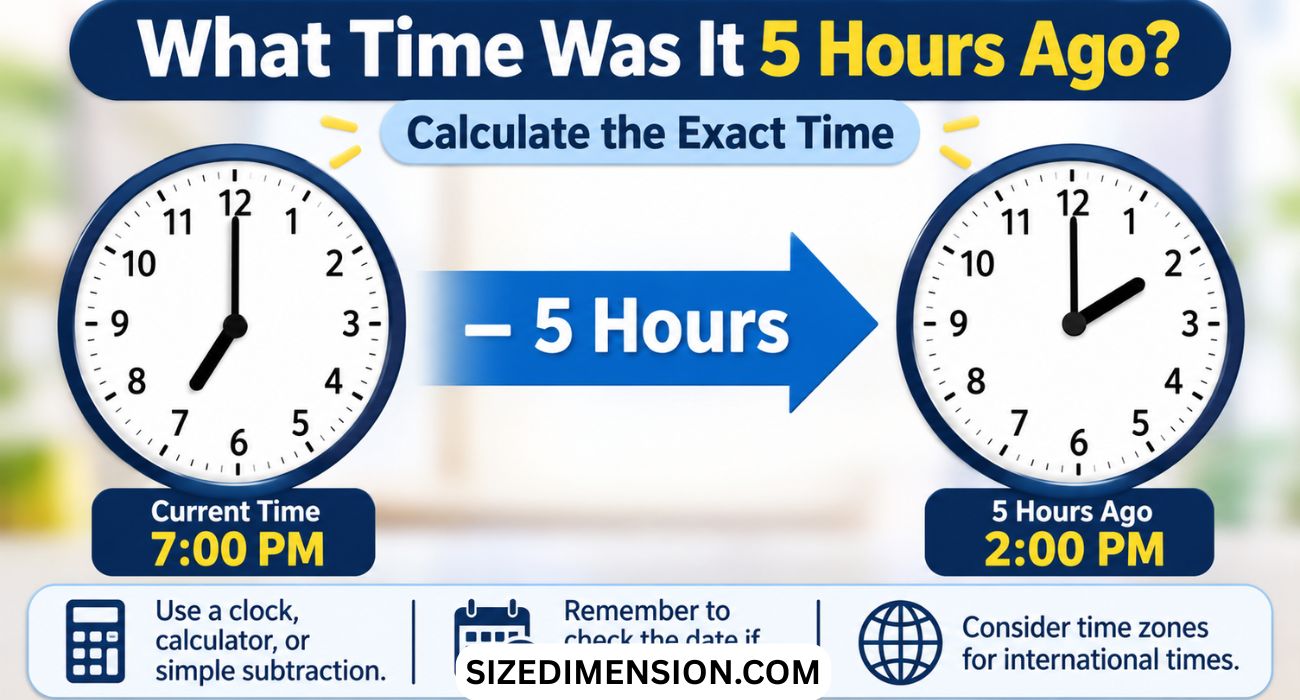
What Time Was It 5 Hours Ago? Calculate the Exact Time
Knowing what time was it five hours ago is useful when checking an earlier event, calculating work hours, reviewing travel schedules, or remembering when something happened. Although subtracting five hours sounds simple, crossing midnight, changing dates, and dealing with different time zones can sometimes make the calculation confusing.
The good news is that you do not need a complicated formula or special software. Simply subtract five hours from the current time to find the answer.
For example, if the current time is 6:00 PM, five hours earlier was 1:00 PM. If it is 3:00 AM, the answer is 10:00 PM on the previous day.
This guide explains how to calculate five hours backward using both clock formats, handle midnight correctly, use online time calculators, and apply the calculation to everyday situations.
Read also: How long until 3:30 PM
Understanding What Time Was It 5 Hours Ago
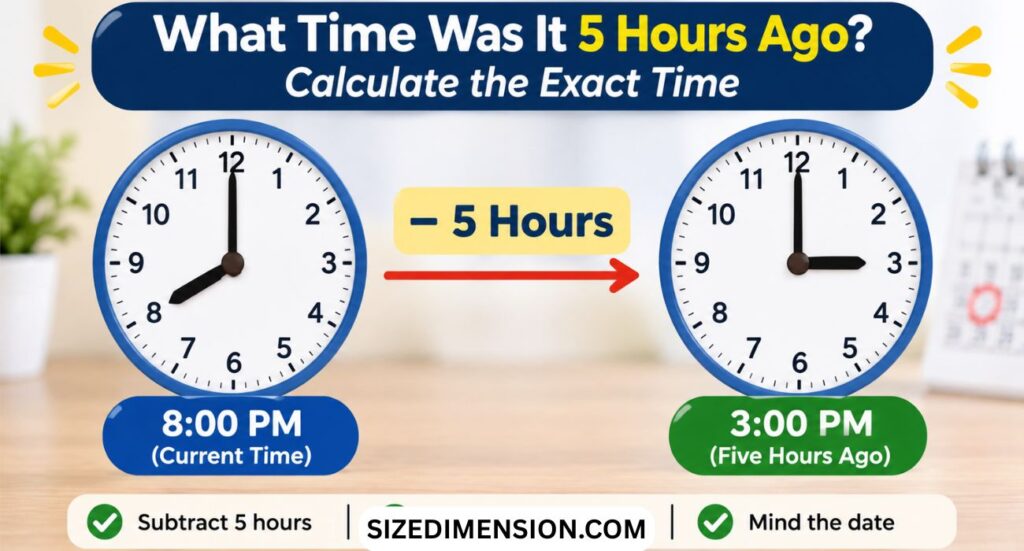
To determine what time it was five hours ago, subtract five hours from the current local time.
The basic formula is:
Previous Time = Current Time − 5 Hours
For example:
- Current time: 8:00 PM
- Subtract: 5 hours
- Previous time: 3:00 PM
Therefore, five hours before 8:00 PM was 3:00 PM on the same day.
The calculation becomes slightly different when the result crosses midnight. In that situation, the answer belongs to the previous calendar day.
Here are some quick examples:
| Current Time | 5 Hours Ago |
|---|---|
| 12:00 PM | 7:00 AM |
| 1:00 PM | 8:00 AM |
| 3:00 PM | 10:00 AM |
| 5:00 PM | 12:00 PM |
| 7:00 PM | 2:00 PM |
| 9:00 PM | 4:00 PM |
| 11:00 PM | 6:00 PM |
| 2:00 AM | 9:00 PM (previous day) |
| 4:00 AM | 11:00 PM (previous day) |
| 6:00 AM | 1:00 AM |
These examples demonstrate that the answer depends on the starting time, not simply the number of hours being subtracted.
How Time Subtraction Actually Works
Time subtraction works differently from ordinary decimal subtraction because a clock follows a repeating 60-minute and 24-hour system.
An hour contains 60 minutes, while a complete day contains 24 hours.
When subtracting five hours, you move backward five positions on the clock without changing the minutes.
For example:
- Starting time: 4:35 PM
- Subtract five hours.
- Keep the minutes at 35.
- Change the hour from 4 PM to 11 AM.
The result is 11:35 AM.
The minutes remain unchanged because the calculation involves complete hours rather than minutes.
However, if you subtract an amount that includes minutes, you must account for borrowing from the previous hour.
For example, subtracting 2 hours and 20 minutes from 3:10 PM requires moving back 20 minutes first and then subtracting two hours.
Understanding this relationship makes more complicated time calculations easier.
Why Reverse Time Calculation Matters in Everyday Life
Working backward from the current time is useful in many situations.
People regularly need to determine when something happened, how much time has passed, or when an activity should have started.
Some common situations include:
- Checking when a meeting ended.
- Determining when a work shift began.
- Reviewing the timing of a flight or journey.
- Remembering when a message was received.
- Calculating the time of a previous medication dose.
- Checking when an online game or live event started.
- Reconstructing an earlier activity from timestamps.
For example, imagine receiving a notification at 7:30 PM and discovering that an event occurred five hours earlier. Subtracting five hours tells you that the event happened at 2:30 PM.
This simple calculation can help organize schedules and understand event timelines.
What Time Was It 5 Hours Ago Using the 12-Hour Clock?
The 12-hour clock divides the day into two periods:
- AM: Midnight through the morning until just before noon.
- PM: Noon through the evening until just before midnight.
When subtracting five hours, you must pay attention to whether the calculation crosses noon or midnight.
Consider these examples:
| Starting Time | Five Hours Earlier |
|---|---|
| 10:00 AM | 5:00 AM |
| 11:00 AM | 6:00 AM |
| 12:00 PM | 7:00 AM |
| 2:00 PM | 9:00 AM |
| 4:00 PM | 11:00 AM |
| 6:00 PM | 1:00 PM |
| 8:00 PM | 3:00 PM |
| 10:00 PM | 5:00 PM |
| 1:00 AM | 8:00 PM (previous day) |
| 3:00 AM | 10:00 PM (previous day) |
The most important detail is remembering when AM changes to PM or PM changes to AM.
For example, five hours before 2:00 AM is 9:00 PM on the previous day, not 9:00 AM.
What Time Was It 5 Hours Ago Using the 24-Hour Clock?
The 24-hour clock represents each hour of the day using numbers from 00 to 23.
It is commonly used in transportation, healthcare, military communication, international scheduling, and computer systems.
The format removes the need for AM and PM.
Here are some examples:
| 24-Hour Starting Time | Five Hours Earlier |
|---|---|
| 06:00 | 01:00 |
| 08:00 | 03:00 |
| 10:00 | 05:00 |
| 12:00 | 07:00 |
| 14:00 | 09:00 |
| 16:00 | 11:00 |
| 18:00 | 13:00 |
| 20:00 | 15:00 |
| 22:00 | 17:00 |
| 01:00 | 20:00 (previous day) |
| 03:00 | 22:00 (previous day) |
To calculate the previous time using the 24-hour system, subtract five from the hour.
If the result is negative, add 24 to obtain the correct hour and move to the previous date.
For example:
03:00 − 05:00 = −02:00
Add 24 hours:
24 − 2 = 22:00
Therefore, five hours before 03:00 was 22:00 (10:00 PM) on the previous day.
Crossing Midnight: The Most Common Mistake
Crossing midnight is one of the most common sources of confusion when calculating earlier times.
A calendar day begins at 12:00 AM and ends immediately before the next midnight.
When you subtract five hours from an early-morning time, the result may belong to the previous calendar date.
For example:
- Current time: 2:00 AM
- Subtract: 5 hours
- Move backward across midnight.
- Result: 9:00 PM on the previous day.
The clock displays 9:00 PM, but the date must also change.
Consider another example:
Suppose the current date is November 9 and the time is 3:00 AM.
Five hours earlier was:
November 8 at 10:00 PM.
This distinction matters when reviewing work records, booking information, transaction timestamps, or messages.
A correct time with an incorrect date can create confusion when matching events.
Manual Time Arithmetic Without a Calculator

You can calculate five hours ago mentally using a straightforward method.
Follow these steps:
- Identify the current hour and minutes.
- Subtract five from the hour.
- Keep the minutes unchanged.
- If the hour becomes zero or negative, add 12 when using the 12-hour clock or 24 when using the 24-hour clock.
- If you cross midnight, move the date back one day.
Let’s look at three practical examples.
Example 1: Calculating Five Hours Before 9:00 PM
Starting time: 9:00 PM
Subtract five hours:
9 − 5 = 4
The answer is 4:00 PM.
No date change is necessary.
Example 2: Calculating Five Hours Before 2:00 AM
Starting time: 2:00 AM
Subtract five hours:
2 − 5 = −3
On a 12-hour clock, move backward across midnight.
The answer is 9:00 PM on the previous day.
Example 3: Calculating Five Hours Before 11:45 AM
Starting time: 11:45 AM
Subtract five hours:
11 − 5 = 6
Keep the minutes unchanged.
The answer is 6:45 AM.
These examples show that subtracting complete hours is relatively straightforward once you understand the clock’s repeating cycle.
Using Online Time Calculators
An online time calculator can help when you need a quick and accurate result without performing the arithmetic manually.
Most time calculators allow you to enter a starting time and specify how many hours and minutes you want to subtract.
For a five-hour calculation, enter:
- Starting time: Your current local time.
- Operation: Subtract.
- Hours: 5.
- Minutes: 0.
The calculator then displays the resulting time.
Some tools also provide the previous calendar date when the calculation crosses midnight.
Advantages of online time calculators:
- Fast calculations.
- Reduced mental arithmetic.
- Convenient for repeated calculations.
- Helpful for complicated hour-and-minute differences.
- Useful for checking schedules.
Limitations to remember:
An online calculator may use the wrong time zone if you enter a time without specifying your location or date. It may also assume a fixed number of hours rather than accounting for daylight saving time transitions.
For ordinary calculations, this is rarely a problem. For travel, international scheduling, or historical timestamps, check the time zone settings carefully.
Time Zones Make Everything More Interesting
Time zones become important when calculating an earlier time associated with a different location.
For example, suppose it is 8:00 PM in one city and you want to know what time it was five hours earlier in that same location.
The answer is 3:00 PM local time.
However, if you are comparing an event in another country, you must first establish which time zone the timestamp represents.
A timestamp may be recorded in:
- Local time.
- Coordinated Universal Time (UTC).
- A different country’s standard time.
- A system-specific time zone.
UTC is a global reference used to coordinate timekeeping around the world.
Another consideration is daylight saving time (DST). Some locations move their clocks forward or backward seasonally.
If a five-hour interval crosses a daylight saving transition, subtracting five from the displayed wall-clock time may not produce the correct elapsed-time result.
For accurate calculations, distinguish between:
Elapsed time: The actual duration between two moments.
Clock time: The time displayed on a local clock.
For example, five elapsed hours across a clock change may correspond to a difference of only four or six displayed clock hours, depending on the transition.
Read more: Requester vs. Requestor: Which Is Correct?
Real-Life Examples of Five-Hour Calculations
Five-hour subtraction is useful in several everyday situations. The following examples demonstrate how the same calculation applies to different activities.
Medication Timing
Medication schedules sometimes require people to check when a previous dose was taken.
For example, if a person took medication at 8:00 AM and wants to identify the time five hours later or earlier, basic time arithmetic can help establish the timeline.
Five hours before 8:00 AM was 3:00 AM.
However, calculating a previous dose time does not establish when the next dose should be taken.
Medication instructions vary depending on the medicine, dosage, formulation, and individual circumstances.
Always follow the prescribed schedule or the instructions on the packaging. Do not change a dosing interval simply because a time calculation suggests a convenient alternative.
Flight Timing
Flight schedules often involve different time zones, making time calculations particularly important.
Suppose a flight departed at 11:00 PM and you want to determine when it departed five hours earlier than a recorded reference time of 4:00 AM.
The answer may involve the previous calendar date.
For international flights, departure and arrival times are generally displayed in the local time of the relevant airport.
This means a five-hour calculation should account for the time zone associated with the timestamp.
When reviewing flight details, check:
- Departure airport time zone.
- Arrival airport time zone.
- Scheduled departure time.
- Actual departure time.
- Date changes during travel.
These details help prevent confusion when comparing flight records.
Shift Calculation
Workers may need to calculate when a shift started by working backward from its ending time.
For example, if a five-hour work period ended at 6:00 PM, the starting time was 1:00 PM.
Other examples include:
| Shift End | Five-Hour Start |
|---|---|
| 12:00 PM | 7:00 AM |
| 2:00 PM | 9:00 AM |
| 5:00 PM | 12:00 PM |
| 8:00 PM | 3:00 PM |
| 11:00 PM | 6:00 PM |
| 3:00 AM | 10:00 PM (previous day) |
Remember that this calculation assumes a continuous five-hour period. Breaks, unpaid intervals, and workplace rules may affect the actual paid working time.
Memory Reconstruction
Sometimes you remember an event but cannot recall its exact time.
For instance, you may remember receiving a phone call approximately five hours before checking your device.
If the current time is 9:30 PM, the estimated time of the call was 4:30 PM.
This approach can help reconstruct a timeline involving:
- Phone calls.
- Text messages.
- Meetings.
- App notifications.
- Online transactions.
- Personal activities.
For greater accuracy, compare your calculation with device timestamps, calendar entries, or other available records.
Gaming
Online gaming sessions, live competitions, and multiplayer events often involve time-based records.
Suppose a gaming session ended at 1:00 AM and lasted five hours.
Working backward gives a starting time of 8:00 PM on the previous day.
This is useful when checking:
- Game session duration.
- Tournament schedules.
- Server event times.
- Recorded gameplay.
- Online activity logs.
For international gaming servers, remember that server timestamps may use UTC rather than your local time.
What Is the Difference Between Five Hours Ago and Five Hours Later?
These expressions describe opposite directions on the timeline.
- Five hours ago means moving backward from the reference time.
- Five hours later means moving forward from the reference time.
For example, if the current time is 4:00 PM:
| Calculation | Result |
|---|---|
| Five hours ago | 11:00 AM |
| Current time | 4:00 PM |
| Five hours later | 9:00 PM |
Understanding this difference prevents mistakes when reading appointment reminders, scheduling activities, or interpreting instructions.
Human Perception Versus Digital Precision
People often estimate earlier times based on memory rather than exact calculations.
For example, someone might say an event happened around five hours ago without knowing its precise starting time.
This is a reasonable estimate for casual conversations, but it may not be sufficient for situations requiring accurate records.
Digital devices provide more precise timestamps, although their accuracy still depends on correct clock settings, synchronization, and time zone information.
Consider the following comparison:
| Method | Best Use | Accuracy |
|---|---|---|
| Mental calculation | Quick everyday estimates | Depends on the calculation |
| Wall clock | Checking displayed local time | Depends on clock accuracy |
| Smartphone clock | Everyday time reference | Usually precise when synchronized |
| Online calculator | Repeated time subtraction | Depends on correct inputs |
| Timestamp records | Reconstructing past events | Depends on system and time zone settings |
For everyday use, mental arithmetic is usually sufficient. For important records, use verified timestamps and confirm their time zone.
See also: How long it will take to reach 12 PM?
Tips for Accurate Reverse Time Calculation
A few simple habits can make backward time calculations easier and more reliable.
1. Start with the correct reference time.
Check the current time before performing the calculation. Avoid mixing a local time with a UTC timestamp.
2. Keep the minutes unchanged.
When subtracting exactly five hours, the minute value remains the same.
3. Check whether midnight is crossed.
If the result falls before 12:00 AM, move to the previous date.
4. Understand AM and PM.
A calculation that moves across noon or midnight may change the AM/PM designation.
5. Use the 24-hour clock when convenient.
The 24-hour format can make time subtraction easier because it avoids AM/PM confusion.
6. Account for time zone changes.
For international travel and historical records, distinguish elapsed time from local clock time.
7. Verify important timestamps.
For medication records, travel schedules, financial transactions, and workplace records, compare your result with an authoritative timestamp.
Frequently Asked Questions
What time was it 5 hours ago?
Five hours ago is the current time minus five hours. For example, if the current time is 7:00 PM, five hours earlier was 2:00 PM. If the current time is 2:00 AM, the answer is 9:00 PM on the previous day.
How many minutes are in 5 hours?
There are 300 minutes in five hours.
Calculation:
5 × 60 = 300 minutes.
How many seconds are in 5 hours?
There are 18,000 seconds in five hours.
Calculation:
5 × 60 × 60 = 18,000 seconds.
What time was it 5 hours ago from 10 PM?
Five hours before 10:00 PM was 5:00 PM on the same day.
Calculation:
10:00 PM − 5 hours = 5:00 PM.
What time was it 5 hours ago from 3 AM?
Five hours before 3:00 AM was 10:00 PM on the previous day.
Calculation:
3:00 AM − 5 hours = 10:00 PM (previous day).
Does the date change when calculating 5 hours ago?
Yes, the date changes when subtracting five hours takes you across midnight.
For example, if it is November 9 at 3:00 AM, five hours earlier was November 8 at 10:00 PM.
If the calculation does not cross midnight, the date remains unchanged.
How do I calculate 5 hours ago manually?
Subtract five from the current hour while keeping the minutes unchanged.
For example, if the current time is 8:45 PM:
8 − 5 = 3.
The result is 3:45 PM.
If the calculation crosses midnight, move to the previous calendar date.
What is 5 hours ago in 24-hour time?
Subtract five from the current hour using the 24-hour clock.
For example:
- 18:00 becomes 13:00.
- 15:00 becomes 10:00.
- 03:00 becomes 22:00 on the previous day.
The 24-hour format makes it easier to avoid AM/PM confusion.
Can an online calculator find the exact time 5 hours ago?
Yes. An online time calculator can subtract five hours from a specified starting time and display the result.
For the most reliable answer, enter the correct starting date, time, and time zone, especially when the calculation involves daylight saving time or international locations.
Does time zone affect the answer?
A time zone does not change the five-hour duration, but it can change the displayed local clock time.
When calculating elapsed time across different time zones or daylight saving transitions, use the correct time zone and date to avoid errors.
Conclusion
Knowing what time was it five hours ago is a simple but useful skill for everyday time management, scheduling, travel planning, work records, and reconstructing past events.
The basic rule is straightforward: subtract five hours from the starting time while keeping the minutes unchanged. If the calculation crosses midnight, remember to move the date back one day.
You can perform this calculation mentally, use the 12-hour or 24-hour clock, or check the result with an online time calculator.
For ordinary situations, simple subtraction is usually enough. For important records involving medication, travel, or international schedules, also consider time zones, daylight saving changes, and the accuracy of the original timestamp.
With these principles, you can calculate five hours backward confidently and avoid common timekeeping mistakes.