3 Ounces: 13 Common Things That Weigh 3 Ounces (With Pic)
3 ounces is a small unit of weight used in the United States. It equals about 85 grams. Many foods and household items weigh close to 3 ounces.
Most people hear about 3 ounces in recipes and serving sizes. But it can be hard to picture. Knowing common examples makes this measurement much easier to understand.
There are many everyday items that weigh about 3 ounces. Examples include two large eggs, a small lime, and a spice jar. These simple comparisons help you estimate 3 ounces quickly.
Read this too: 2 mm: 13 Most Common Things That Are 2mm
What Is 3 Ounces?
The term 3 ounces refers to a unit of measurement commonly used in the United States. Depending on the situation, it can refer to weight or volume. This is why it is important to understand the difference between a dry ounce and a fluid ounce.
A dry ounce measures weight, while a fluid ounce measures volume. For example, meat, cheese, spices, and bread are measured by weight. Water, milk, juice, and cooking oil are measured by volume. Understanding this difference helps avoid mistakes in recipes and food preparation.
The following table shows some useful conversions for a 3 oz measurement.
| Measurement | Equivalent |
| 3 ounces in grams | 85 grams |
| 3 ounces in ml | 88.7 ml |
| 3 fluid ounces | 88.7 ml |
| 3 oz in cups | 0.375 cup |
| 3 oz in tablespoons | 6 tablespoons |
| 3 oz in teaspoons | 18 teaspoons |
Understanding these values makes weight conversion, volume conversion, and everyday kitchen measurements much easier.
Why 3 Ounces Is Important
A 3 oz serving size is commonly used in nutrition guides and food labels. The USDA often uses a three-ounce serving when discussing recommended portions of chicken, fish, and lean meats. This makes 3 ounces one of the most important measurements in healthy eating and meal planning.
How Much Is 3 Ounces? 13 Common Things That Weigh 3 Ounces
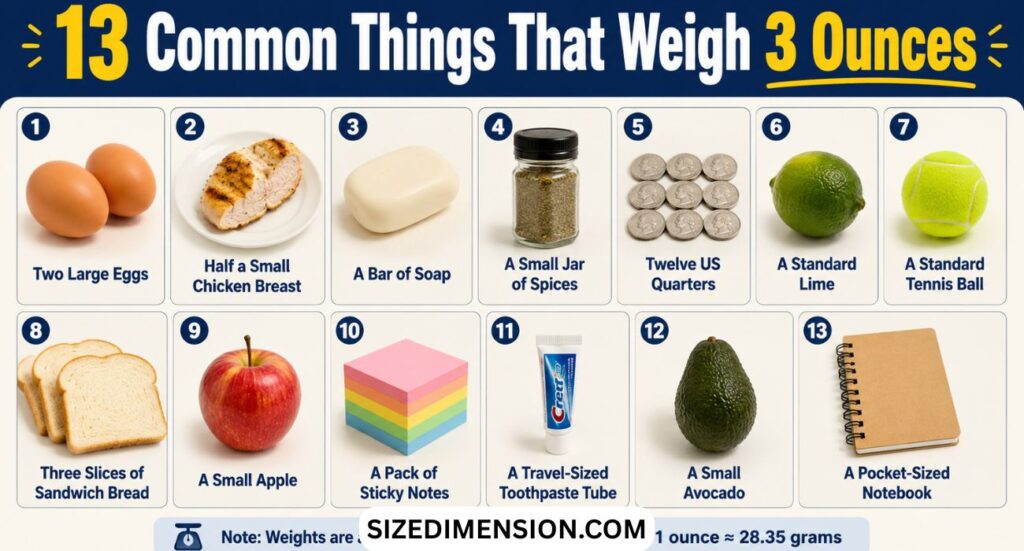
One of the easiest ways to understand how much is 3 ounces is to compare it to familiar objects. These common things that weigh 3 ounces can help you estimate weight when you do not have a scale nearby.
Two Large Eggs
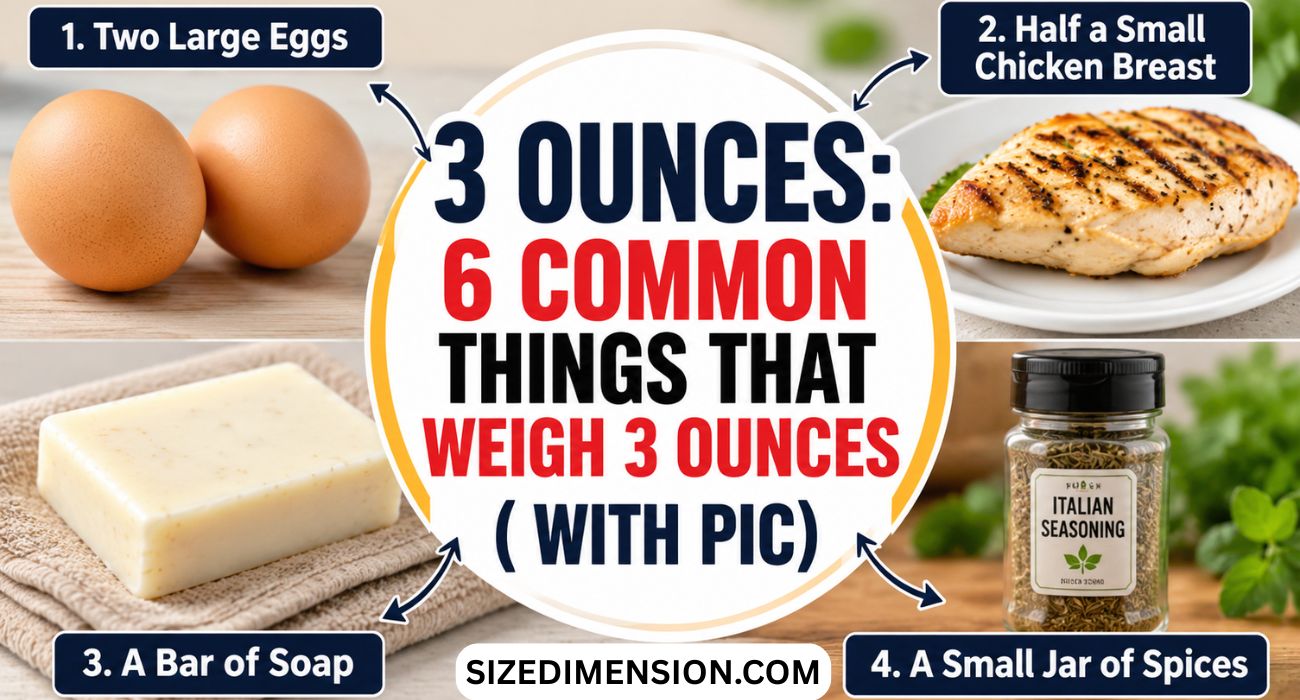
Two large eggs provide one of the simplest examples of things that weigh 3 ounces. A large egg typically weighs around 1.5 ounces, so two eggs come very close to the three-ounce mark.
Most people keep eggs in their kitchen, making them a practical reference. If you hold two large eggs in your hand, you get a fairly accurate sense of what 85 grams feels like. This comparison is useful when learning how to measure 3 ounces without specialized equipment.
Half a Small Chicken Breast
A half chicken breast is another excellent example. A small chicken breast often weighs about 6 ounces when cooked. Cutting it in half creates a portion very close to 3 oz of chicken.
This amount is frequently recommended as a USDA serving size and is considered a healthy food portion size. Nutrition experts often describe a 3 oz of chicken serving as being similar to a deck of cards size or a palm size portion.
This comparison is especially helpful when preparing healthy meals or following a protein portion guide.
A Bar of Soap
A travel size soap bar commonly weighs around three ounces. Many travel products are designed around airline restrictions, making this a convenient household weight reference.
If you have ever packed a soap bar for a trip, you have probably held an object that closely matches the weight of 3 ounces. This makes it a useful everyday weight comparison.
A Small Jar of Spices
A small spice jar often weighs close to three ounces. Popular examples include containers of garlic powder, Italian seasoning, ground cinnamon, and crushed red pepper.
These products are found in almost every American kitchen. Because spices are dense, their containers provide a useful visual reference for understanding food weight examples.
| Spice | Typical Weight |
| Garlic powder | 3 oz |
| Italian seasoning | 2–3 oz |
| Ground cinnamon | 2.5–3 oz |
| Crushed red pepper | 2–3 oz |
Twelve US Quarters
Many people use US quarters as a coin weight reference. Coins have standardized weights, making them useful for simple weight estimates.
While quarters provide a handy comparison tool, they are best used as a general guide rather than an exact measurement. They can help demonstrate how small amounts of weight add up and improve your understanding of weight estimation.
A Standard Lime
A fresh lime is another one of the easiest everyday items that weigh 3 ounces. The average lime weight falls close to this range, depending on size and moisture content.
Because limes are commonly used in drinks, cooking, and baking, they provide an easy way to visualize 3 ounces. The citrus fruit weight of a lime makes it a memorable reference point.
A Standard Tennis Ball
A standard tennis ball weighs close to 2 to 3 ounces depending on the brand and manufacturing specifications. It is commonly used as a quick visual reference when estimating small weights and understanding everyday measurements without using scales at home.
Many people have handled a tennis ball during sports or recreation activities. Its familiar size and feel make it useful for comparing objects that are near three ounces and for improving weight estimation skills in practical daily situations.
Read also: Celsius Can Dimensions
Three Slices of Sandwich Bread
Three slices of regular sandwich bread usually weigh around three ounces in total. Bread is found in most kitchens, making it a convenient comparison when learning common kitchen measurements and understanding food serving sizes more accurately today.
Because bread is lightweight and familiar, it helps people estimate portions without specialized tools. Comparing three slices together provides a simple way to visualize three ounces during meal preparation, recipe planning, and everyday cooking activities at home.
A Small Apple
A small apple often weighs close to three ounces, although exact weight varies by variety and growing conditions. This fruit offers a natural example for understanding everyday weights and helps people estimate portions while shopping or preparing meals.
Since apples are common in homes, schools, and workplaces, they serve as practical weight references. Holding a small apple provides a quick sense of what three ounces feels like and supports better portion awareness during daily food choices.
A Pack of Sticky Notes
A standard pack of sticky notes can weigh about three ounces depending on sheet count and paper thickness. Office supplies like these offer useful non-food examples that help explain weight measurements in a simple and familiar manner.
People frequently use sticky notes for reminders, planning, and organization tasks. Their compact shape and manageable size make them effective references when estimating weights and understanding how three ounces compares to other common household objects.
A Travel-Sized Toothpaste Tube
Many travel-sized toothpaste tubes weigh approximately three ounces when full. These products are designed for convenience and portability, making them familiar examples for understanding small weight measurements and everyday item comparisons during trips and regular activities.
Travel products are especially useful references because people often handle them before flights. A toothpaste tube weighing around three ounces helps demonstrate how small this measurement feels and supports better understanding of practical weight estimation methods.
A Small Avocado
A small avocado may weigh around three ounces depending on its variety and ripeness. This nutritious fruit provides a useful kitchen reference and helps people understand weight measurements while preparing meals, snacks, and healthy recipes throughout the week.
Because avocados are popular ingredients in many dishes, they offer an easy comparison point. Holding a small avocado gives a realistic impression of three ounces and helps improve portion awareness without relying on scales for every measurement.
A Pocket-Sized Notebook
A pocket-sized notebook often weighs close to three ounces, especially when it contains a moderate number of pages. It serves as a practical example outside the kitchen and helps people relate weight measurements to familiar everyday belongings.
Students, professionals, and travelers commonly carry small notebooks for writing notes and ideas. Their convenient size and recognizable weight make them useful references when visualizing three ounces and estimating the weight of similar household items.
How Much Is 3 Ounces of Liquid?
Many people ask about 3 oz of liquid because liquid measurements appear frequently in recipes and beverages.
A 3 fluid ounces serving equals 88.7 ml, which is slightly less than 100 ml. This amount is commonly used for sauces, cooking oils, dressings, and beverages.
The table below shows useful liquid conversions.
| Liquid Measurement | Equivalent |
| 3 fluid ounces | 88.7 ml |
| 3 oz in tablespoons | 6 tablespoons |
| 3 oz in cups | 0.375 cup |
| Teaspoons | 18 teaspoons |
Understanding fluid ounce conversion helps improve accuracy when following recipes and making cooking measurements.
An interesting fact is that the TSA liquid limit allows containers up to 3.4 ounces or 100 ml. Because 3 oz of liquid is below this threshold, many travel products fit comfortably within airline guidelines for travel liquid containers.
How to Measure 3 Ounces Without a Scale
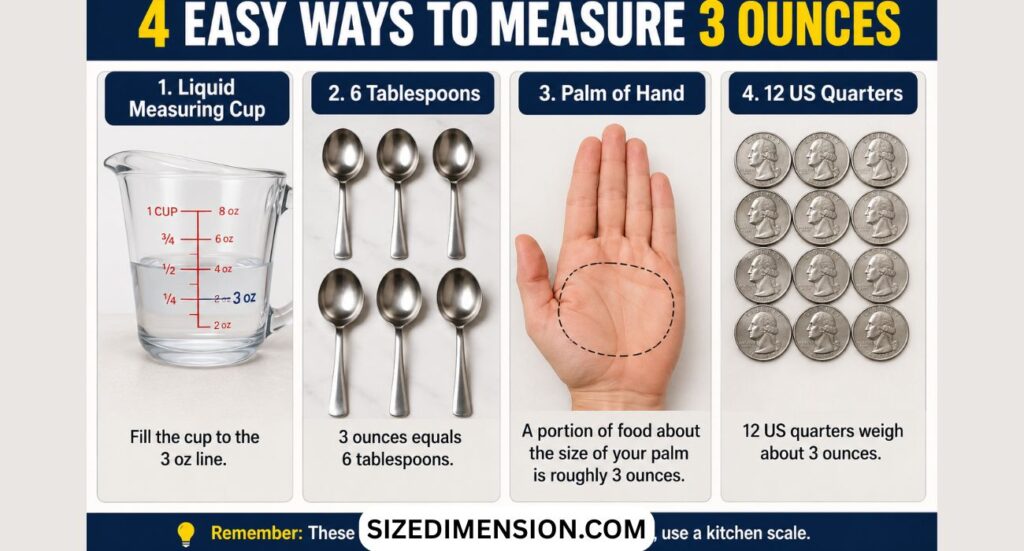
Many people need a quick method for measuring without a scale. Fortunately, several practical options can help.
Use a Liquid Measuring Cup
A liquid measuring cup is one of the easiest tools available. Most measuring cups have ounce markings. Simply fill the liquid to the 3-ounce line.
This method works well for water, milk, juice, oils, and other liquids. It is one of the most accurate kitchen scale alternative methods for liquids.
Count 6 Tablespoons
A simple tablespoons to ounces conversion can help when measuring liquids.
Since one fluid ounce equals two tablespoons, three ounces equals six tablespoons. This shortcut is commonly used in recipes and daily cooking conversions.
Use the Palm Method for Proteins
The palm method is one of the most popular techniques for estimating meat portions. A serving about the size of your palm generally equals a 3 oz serving size.
This method is frequently recommended in portion control guide resources because it provides a fast way to estimate portions during meals.
Stack 12 US Quarters
Using US quarters offers another practical comparison. While not intended to replace a scale, this method helps provide a rough visual estimate and serves as a useful household weight reference.
3 Ounces in Cooking and Portion Control
Understanding 3 ounces plays a major role in healthy eating. Many nutrition programs and government guidelines recommend a three-ounce serving of protein.
The USDA uses this amount as a standard nutrition serving size for meats and poultry. This is why you often see 3 oz of chicken listed in meal plans and healthy eating guides.
Common Foods Served in 3-Ounce Portions
| Food | Typical 3-Ounce Serving |
| Chicken | Palm-sized portion |
| Fish | Deck of cards size |
| Turkey | Palm-sized portion |
| Lean beef | Deck of cards size |
Learning these comparisons helps with meal prep portions, calorie management, and healthy eating habits. It also improves understanding of ounces in cooking and ounces in nutrition.
“Portion awareness is one of the simplest ways to support healthy eating habits.”
When people learn to recognize a food serving reference, they often find it easier to maintain balanced diets and control calorie intake.
Why Knowing 3 Ounces Matters in Everyday Life
Understanding 3 ounces helps people make better decisions when cooking, shopping, and tracking nutrition. Many food labels use ounce measurements, so knowing the size and weight of common portions can prevent confusion. This knowledge is useful for families, students, and anyone who follows recipes or meal plans on a regular basis.
People often estimate portions without realizing how much they are actually consuming. Learning to recognize 3 oz through familiar objects improves accuracy and confidence. It also supports healthy eating habits and better food awareness. Whether preparing meals or packing snacks, understanding this measurement makes everyday tasks much easier and more practical.
3 Ounces Compared to Other Common Measurements
Many people find it easier to understand 3 ounces by comparing it with other measurements. Three ounces equals approximately 85 grams, 3/8 cup, and six tablespoons. These conversions help when following recipes that use different measurement systems. Understanding these relationships reduces mistakes and improves consistency in cooking and baking tasks.
Comparisons also make measurement easier when tools are unavailable. A person who understands ounces, grams, cups, and tablespoons can switch between systems comfortably. This flexibility is valuable in American kitchens where recipes may use various units. Knowing these conversions helps save time and improves confidence during food preparation and meal planning.
Common Uses of 3 Ounces in American Kitchens
In many American homes, 3 ounces appears frequently in recipes, meal plans, and serving recommendations. Chefs and home cooks often measure meats, sauces, and ingredients using this amount. Because it is a manageable portion size, it works well for balanced meals and accurate ingredient preparation in daily cooking activities.
Cooking becomes simpler when people recognize what 3 oz looks like. Instead of constantly weighing food, they can use visual references learned from experience. This approach speeds up meal preparation and reduces guesswork. Over time, understanding common measurements leads to more consistent results and greater confidence in the kitchen.
Understanding Weight Versus Volume Measurements
One of the most important concepts in measurement is understanding the difference between weight and volume. Weight measures how heavy an item is, while volume measures the amount of space a liquid occupies. This distinction explains why 3 ounces and 3 fluid ounces are not always interchangeable in recipes.
Many cooking mistakes happen because people confuse these measurements. Dry ingredients such as meat, cheese, and spices use weight measurements. Liquids such as water, milk, and oil use volume measurements. Learning the difference helps improve recipe accuracy and creates better results when preparing meals, drinks, and baked goods.
How 3 Ounces Helps With Healthy Portion Control
Nutrition experts often recommend 3 ounces as a standard serving size for protein-rich foods. This amount provides a balanced portion that fits easily into healthy meal plans. Understanding this serving size helps individuals manage calorie intake while still enjoying satisfying meals throughout the day and evening.
Portion control is easier when people can identify a 3 oz serving size without measuring tools. Familiar comparisons such as a palm-sized piece of meat simplify daily eating decisions. This method encourages balanced nutrition and helps prevent overeating. Small habits like these can support long-term health and wellness goals.
See also: Can Koozie Dimensions: Size, Height
Fun Ways to Visualize 3 Ounces
Learning through visual examples makes measurements easier to remember. Everyday objects such as eggs, spice jars, soap bars, and limes provide practical references for 3 ounces. These familiar items help people build a mental picture of the measurement and estimate weights more accurately without using specialized equipment.
Visual comparisons are especially useful for children, beginners, and anyone unfamiliar with kitchen measurements. Instead of memorizing numbers alone, they can connect ounces with real objects they see regularly. This simple learning method improves understanding and makes estimating 3 oz more natural in everyday situations and daily activities.
FAQ’s
What is something that is 3 ounces?
A small lime, a travel-size bar of soap, or a small spice jar typically weighs about 3 ounces.
These everyday items provide an easy way to visualize and understand a 3 oz measurement.
What does 3 oz weigh?
3 oz weighs approximately 85 grams or 0.1875 pounds.
It is about the weight of two large eggs or a standard palm-sized serving of cooked chicken.
What items are 6 ounces?
A medium chicken breast, a large apple, or two small bars of soap can weigh around 6 ounces.
Six ounces is exactly double the weight of a standard 3 oz serving size.
What do 3 ounces look like?
3 ounces looks similar to a deck-of-cards-sized portion of meat or two large eggs.
It can also be compared to a small lime or a compact spice container found in most kitchens.
Final Thoughts
Understanding 3 ounces becomes much easier when you compare it to familiar objects. Whether you use two large eggs, a half chicken breast, a travel size soap bar, a small spice jar, US quarters, or a lime, these examples help you quickly recognize things that weigh 3 ounces in everyday life.
Knowing how much is 3 ounces, understanding 3 ounces in grams, learning 3 ounces in ml, and mastering basic recipe measurements can make cooking, nutrition tracking, and portion control much easier. By using these practical examples and simple conversions, you can confidently estimate 3 oz, understand ounces explained, and handle common food weight examples without needing a scale every time.