
How Long Until 4:30 PM? Simple Time Guide, Examples & Calculator
Knowing how many minutes remain until a specific time can make everyday planning much easier. Whether you are waiting for an appointment, preparing for work, finishing school, cooking dinner, or getting ready for an online meeting, knowing the time remaining until 4:30 PM helps you organize your schedule.
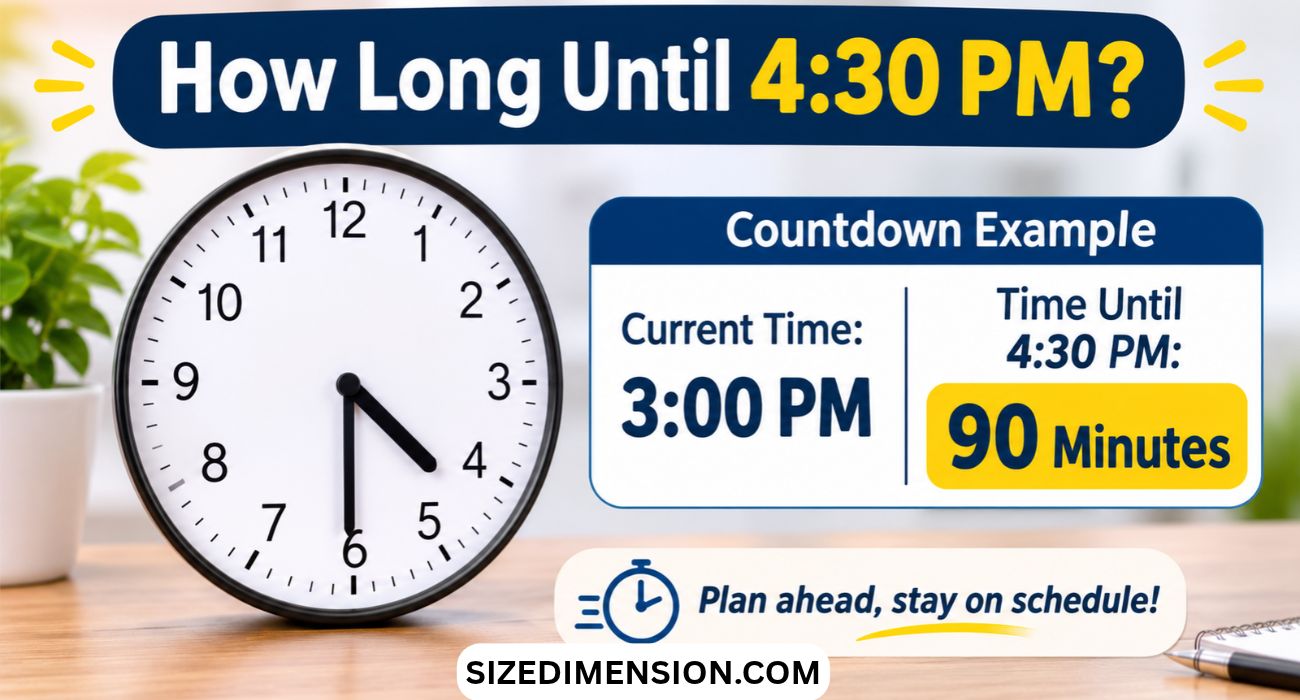
If you are wondering how many minutes until 4:30 PM today, the answer depends on your current local time. For example, if it is 3:00 PM, there are 90 minutes left. If it is 4:00 PM, only 30 minutes remain.
However, if 4:30 PM has already passed, today’s target is in the past. You will need to wait until 4:30 PM tomorrow for its next occurrence.
This guide explains how to calculate the remaining minutes, understand different time formats, avoid common mistakes, and use simple examples to work out the countdown accurately.
Read also: How many hours until 2:35 PM today?
Meaning / Definition
The phrase “How long until 4:30 PM?” refers to the amount of time remaining between the current time and 4:30 in the afternoon.
It measures the difference between two points on a clock:
- Current time: The time right now in your local time zone.
- Target time: 4:30 PM.
- Remaining time: The number of minutes or hours between the two times.
For example, if your clock shows 2:30 PM, you have exactly two hours until 4:30 PM.
Since one hour contains 60 minutes:
2 × 60 = 120 minutes.
Therefore, 120 minutes remain.
The calculation changes throughout the day because every passing minute reduces the remaining time.
Meaning in Simple Words
In simple words, asking how many minutes until 4:30 PM means asking how much longer you must wait before the clock reaches 4:30 in the afternoon.
It is a straightforward countdown that helps you understand the time available before a particular activity or event begins.
Quick Answer
The number of minutes until 4:30 PM depends on your current time.
Here are some quick examples:
| Current time | Time until 4:30 PM |
|---|---|
| 12:00 PM | 270 minutes |
| 1:00 PM | 210 minutes |
| 2:00 PM | 150 minutes |
| 3:00 PM | 90 minutes |
| 3:30 PM | 60 minutes |
| 4:00 PM | 30 minutes |
| 4:15 PM | 15 minutes |
| 4:29 PM | 1 minute |
| 4:30 PM | 0 minutes |
These examples assume the current time is on the same day and before 4:30 PM.
Today’s date-specific answer: At 10:49 PM on November 10, 2026, 4:30 PM today has already passed by 499 minutes (8 hours and 19 minutes). The next 4:30 PM is tomorrow, November 11, which is 1,061 minutes away.
Real-Life Examples

Understanding time calculations becomes easier when you connect them with everyday situations. Here are seven practical examples of how people use the 4:30 PM countdown.
Example 1: Planning an Appointment
Imagine you have a doctor’s appointment scheduled for 4:30 PM, and your current time is 2:00 PM.
First, calculate the difference:
- From 2:00 PM to 4:00 PM = 120 minutes.
- From 4:00 PM to 4:30 PM = 30 minutes.
Total: 120 + 30 = 150 minutes.
You have 2 hours and 30 minutes before your appointment.
This information helps you decide when to leave, prepare your documents, and arrange transportation.
Example 2: Waiting for School to End
Suppose your school finishes at 4:30 PM, but the current time is 3:45 PM.
The calculation is simple:
- From 3:45 PM to 4:00 PM = 15 minutes.
- From 4:00 PM to 4:30 PM = 30 minutes.
Total = 45 minutes.
You have 45 minutes remaining before the school day ends.
Example 3: Preparing for Work
Imagine you have to submit an important assignment by 4:30 PM. It is currently 1:30 PM.
From 1:30 PM to 4:30 PM is exactly three hours.
In minutes:
3 × 60 = 180 minutes.
You have 180 minutes to complete your work, review the details, and submit it before the deadline.
Example 4: Cooking Dinner
Suppose you are preparing dinner for your family, and you want the meal ready at 4:30 PM.
Your current time is 3:50 PM.
The difference is:
- 3:50 PM to 4:00 PM = 10 minutes.
- 4:00 PM to 4:30 PM = 30 minutes.
Total = 40 minutes.
You have 40 minutes to finish cooking and prepare the table.
Example 5: Catching a Bus
Imagine your bus is scheduled to arrive at 4:30 PM, and your clock shows 4:05 PM.
You calculate:
4:30 − 4:05 = 25 minutes.
You have 25 minutes before the scheduled arrival time.
However, remember that bus schedules can change because of traffic or operational delays. A countdown tells you the scheduled time remaining, not necessarily the actual arrival time.
Example 6: Online Meeting
Suppose you have an online meeting at 4:30 PM, and it is currently 3:20 PM.
You can calculate the remaining time as follows:
- 3:20 PM to 4:20 PM = 60 minutes.
- 4:20 PM to 4:30 PM = 10 minutes.
Total = 70 minutes.
You have 1 hour and 10 minutes to prepare your presentation, check your internet connection, and open the meeting link.
Example 7: When 4:30 PM Has Passed
What happens if the current time is 5:00 PM?
In this situation, 4:30 PM has already passed by 30 minutes.
If you mean the next upcoming 4:30 PM, you must calculate the time until tomorrow:
- 5:00 PM to midnight = 7 hours.
- Midnight to 4:30 AM = 4 hours and 30 minutes.
- 4:30 AM to 4:30 PM = 12 hours.
Total = 23 hours and 30 minutes, or 1,410 minutes.
This distinction is important because a past target time cannot be treated as an upcoming event on the same day.
Synonyms and Related Terms
People use several different expressions when asking how much time remains before a particular clock time.
These phrases have similar meanings:
- Minutes remaining until 4:30 PM
- Time left before 4:30
- Countdown to 4:30 PM
- Time difference between now and 4:30 PM
- How much longer until half past four?
- Remaining time until 4:30 in the afternoon
- Minutes left before the afternoon deadline
Although the wording changes, the basic idea remains the same: finding the difference between the current time and the target time.
AM vs. PM
Understanding AM and PM is essential when calculating time.
The 12-hour clock divides the day into two periods.
| Term | Meaning | Example |
|---|---|---|
| AM | Before noon | 4:30 AM |
| PM | After noon | 4:30 PM |
4:30 AM means half past four in the early morning.
4:30 PM means half past four in the afternoon.
These times are exactly 12 hours apart.
Confusing AM and PM can lead to missed appointments, incorrect reminders, and scheduling mistakes.
When to Use a 4:30 PM Countdown
A countdown to 4:30 PM can be useful in many everyday situations.
Use It for Appointments
If you have a medical appointment, consultation, or scheduled visit, calculating the remaining time helps you prepare and leave on time.
Use It for Work
Employees can use a countdown to manage deadlines, finish assignments, prepare reports, and organize their afternoon tasks.
Use It for School
Students can calculate how much time remains before classes finish, examinations begin, or after-school activities start.
Use It for Travel
Knowing the minutes remaining before 4:30 PM can help you prepare for a bus, train, flight check-in, or planned departure.
Always account for travel time and possible delays.
Use It for Reminders
A countdown is helpful when setting reminders for phone calls, online appointments, meetings, and other scheduled activities.
Use It for Countdowns
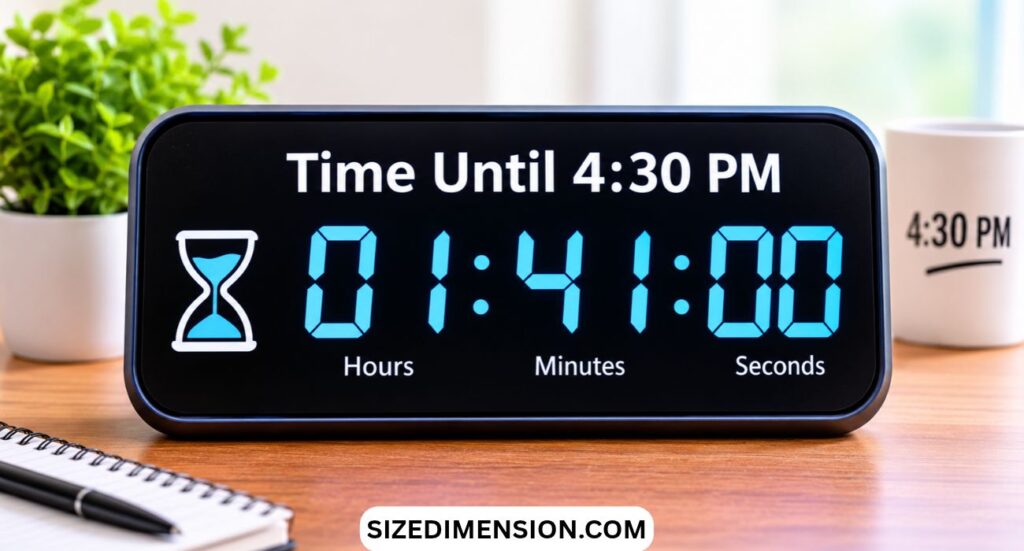
Digital countdown timers can display the remaining hours, minutes, and seconds before 4:30 PM.
They are particularly useful when you need a continuously updated display rather than calculating the difference manually.
Use It for Daily Planning
You can divide your available time into smaller activities.
For example, if you have 90 minutes before 4:30 PM, you might spend:
- 30 minutes completing an assignment.
- 20 minutes answering emails.
- 20 minutes preparing for a meeting.
- 20 minutes reviewing your work.
This approach makes time management easier.
How to Calculate the Time Until 4:30 PM
You do not need a complicated formula to calculate the remaining minutes.
Follow these simple steps.
If the Current Time Is Before 4:30 PM
Subtract the current time from 4:30 PM.
For example, if it is 2:45 PM:
- 2:45 PM to 3:45 PM = 60 minutes.
- 3:45 PM to 4:30 PM = 45 minutes.
Total = 105 minutes.
Therefore, 105 minutes remain.
If the Current Time Is After 4:30 PM
Today’s 4:30 PM has already passed.
If you want to know when the next 4:30 PM will arrive, calculate the difference between the current time and 4:30 PM tomorrow.
For example, if it is 6:00 PM:
- 6:00 PM to midnight = 360 minutes.
- Midnight to 4:30 PM = 990 minutes.
Total = 1,350 minutes.
The next 4:30 PM is 1,350 minutes away.
If the Current Time Is Exactly 4:30 PM
The remaining time is zero minutes.
You have reached the target time.
If you are asking about the next occurrence, tomorrow’s 4:30 PM is 24 hours or 1,440 minutes away.
When NOT to Use a Fixed 4:30 PM Countdown
Although time calculations are straightforward, certain situations require additional attention.
Do Not Ignore the Date
A target time must always be considered alongside its date.
If today is November 10 and it is already 5:00 PM, today’s 4:30 PM is in the past. Tomorrow’s 4:30 PM is a different target.
Do Not Confuse AM and PM
Always confirm whether the intended time is 4:30 AM or 4:30 PM.
The difference is 12 hours, which can significantly affect your schedule.
Do Not Ignore Time Zones
If you are attending an international meeting or scheduling an online event, confirm the time zone.
For example, 4:30 PM in Pakistan is not necessarily 4:30 PM in the United Kingdom or United States.
Do Not Assume the Answer Stays the Same
The remaining minutes decrease continuously.
A calculation showing 90 minutes at 3:00 PM will show only 60 minutes at 3:30 PM.
Do Not Use a Fixed Answer for a Live Countdown
A manually calculated answer is accurate only for the time at which you calculate it.
For a continuously updated result, use a digital timer or clock that calculates the remaining time automatically.
Read more: How long until 3:30 PM
Common Mistakes When Calculating Time
Even simple time calculations can become confusing when people overlook minutes, dates, or clock formats.
Here are seven common mistakes to avoid.
Mistake 1: Subtracting the Wrong Hour
Some people subtract only the hour numbers without considering the minutes.
For example, calculating from 3:45 PM to 4:30 PM as one hour is incorrect.
The actual difference is 45 minutes.
Mistake 2: Forgetting the Minutes
Always account for the minutes after calculating the hour difference.
For example, 2:15 PM to 4:30 PM is 135 minutes, not 120 minutes.
Mistake 3: Treating 4:30 PM as 4:30 AM
AM and PM represent different parts of the day.
A 4:30 AM deadline and a 4:30 PM deadline are separated by 12 hours.
Mistake 4: Forgetting Tomorrow
If 4:30 PM has already passed, the next occurrence is tomorrow.
Always check whether your target belongs to today or the following day.
Mistake 5: Using the Wrong Time Zone
When calculating time for someone in another country, use the target location’s local time.
Otherwise, your answer may be incorrect even if the subtraction is mathematically accurate.
Mistake 6: Rounding the Answer
If the difference is 37 minutes, do not round it to 40 minutes when an exact countdown is required.
Accurate minutes are especially important for appointments and deadlines.
Mistake 7: Confusing Elapsed Time With Remaining Time
Elapsed time measures how long something has already been happening.
Remaining time measures how long is left before an event.
For example, if it is 4:45 PM, then 15 minutes have elapsed since 4:30 PM. The next 4:30 PM is still 23 hours and 45 minutes away.
Comparison With Similar Terms
Understanding related clock expressions helps you calculate time more confidently.
4:30 PM in Different Formats
The same time can be represented in several ways.
| Time format | Representation |
|---|---|
| 12-hour clock | 4:30 PM |
| 24-hour clock | 16:30 |
| Spoken English | Half past four |
| Written English | Four thirty in the afternoon |
| Minutes after midnight | 990 minutes |
In the 24-hour clock, 4:30 PM becomes 16:30 because 12 is added to the afternoon hour.
Understanding the Calculation With More Examples
Here are additional examples that demonstrate how the countdown changes throughout the afternoon.
| Current time | Remaining time | In hours and minutes |
|---|---|---|
| 12:30 PM | 240 minutes | 4 hours |
| 1:15 PM | 195 minutes | 3 hours 15 minutes |
| 1:45 PM | 165 minutes | 2 hours 45 minutes |
| 2:15 PM | 135 minutes | 2 hours 15 minutes |
| 2:45 PM | 105 minutes | 1 hour 45 minutes |
| 3:15 PM | 75 minutes | 1 hour 15 minutes |
| 3:45 PM | 45 minutes | 45 minutes |
| 4:10 PM | 20 minutes | 20 minutes |
| 4:25 PM | 5 minutes | 5 minutes |
These examples assume the target is 4:30 PM on the same day.
What If It Is 4:31 PM?
If your current time is 4:31 PM, today’s 4:30 PM has passed by one minute.
You cannot have a positive remaining countdown to today’s target.
The next 4:30 PM is tomorrow, which is 23 hours and 59 minutes away.
In minutes:
23 × 60 + 59 = 1,439 minutes.
What If It Is Midnight?
Midnight marks the beginning of a new calendar day.
If the current time is 12:00 AM, 4:30 PM is 16 hours and 30 minutes away.
In minutes:
(16 × 60) + 30 = 990 minutes.
What If It Is Noon?
Noon is 12:00 PM.
From noon until 4:30 PM, the calculation is:
- 12:00 PM to 4:00 PM = 4 hours.
- 4:00 PM to 4:30 PM = 30 minutes.
Total = 4 hours and 30 minutes.
In minutes:
(4 × 60) + 30 = 270 minutes.
A Simple Formula for Calculating Remaining Minutes
You can use a basic mathematical formula to calculate the time difference between two clock readings.
Formula:
Remaining minutes = (Target time in minutes − Current time in minutes).
To use this formula, first convert both times into minutes after midnight.
For example:
Current time = 3:15 PM.
Convert it into minutes:
(15 × 60) + 15 = 915 minutes.
Target time = 4:30 PM.
Convert it into minutes:
(16 × 60) + 30 = 990 minutes.
Now subtract:
990 − 915 = 75 minutes.
Therefore, 75 minutes remain until 4:30 PM.
If the target time has passed, add 1,440 minutes to the target time before subtracting the current time. This accounts for the next calendar day.
This method works for any target time, not just 4:30 PM.
See also: How Long Until 3:00 PM?
Tips for Managing Time Before 4:30 PM
Knowing the remaining minutes is useful, but using them wisely is even more important.
Here are some practical suggestions:
- Set an alarm: Create a reminder 10 or 15 minutes before your scheduled event.
- Prepare in advance: Gather documents, equipment, or other necessary items before the deadline.
- Break down tasks: Divide larger activities into smaller, manageable steps.
- Avoid unnecessary distractions: Focus on important work when time is limited.
- Check your clock: Make sure your device displays the correct local time.
- Use a countdown timer: A digital timer helps you monitor the remaining time without repeatedly calculating it.
A little preparation can prevent last-minute stress and help you stay organized.
FAQs
How long until 4:30 PM from 3:00 PM?
There are 90 minutes between 3:00 PM and 4:30 PM.
The calculation is:
1 hour = 60 minutes.
30 minutes = 30 minutes.
Total = 90 minutes.
How long until 4:30 PM from 4:00 PM?
There are exactly 30 minutes between 4:00 PM and 4:30 PM.
How long until 4:30 PM from 2:00 PM?
There are 150 minutes between 2:00 PM and 4:30 PM.
That equals 2 hours and 30 minutes.
How many minutes are in 4 hours and 30 minutes?
Four hours and 30 minutes equal 270 minutes.
Calculation:
(4 × 60) + 30 = 270 minutes.
What is 4:30 PM in 24-hour time?
4:30 PM is written as 16:30 in the 24-hour clock format.
To convert afternoon hours to 24-hour time, add 12 to the hour number.
What happens if it is already 4:30 PM?
If the current time is exactly 4:30 PM, the countdown is zero minutes.
The target time has arrived. If you mean the next occurrence, tomorrow’s 4:30 PM is 1,440 minutes away.
What happens if it is after 4:30 PM?
If the current time is later than 4:30 PM, today’s target has passed.
For the next occurrence, calculate the difference between the current time and 4:30 PM tomorrow.
Is 4:30 PM morning or afternoon?
4:30 PM is in the afternoon. PM refers to the period after noon and before midnight.
How do I calculate the time until 4:30 PM?
Subtract the current time from 4:30 PM after converting both times into minutes. If 4:30 PM has passed, calculate the difference to tomorrow’s 4:30 PM instead.
Why does the answer change throughout the day?
The answer changes because time continuously moves forward. Every minute that passes reduces the remaining countdown by one minute until 4:30 PM arrives.
Conclusion
Knowing how many minutes until 4:30 PM today is a simple but useful way to manage your daily schedule. Whether you are preparing for work, waiting for school to finish, attending an appointment, or planning an evening activity, an accurate countdown helps you stay organized.
The calculation depends on your current local time. For example, there are 90 minutes remaining at 3:00 PM, 30 minutes at 4:00 PM, and zero minutes at exactly 4:30 PM.
If the target time has already passed, remember to calculate the difference to the following day’s 4:30 PM.
Use the examples and simple formula in this guide to calculate the remaining minutes accurately, avoid common timekeeping mistakes, and make better use of your day.