How Long Until 2:30 PM? Countdown Timer & Exact Time Remaining
Have you ever looked at the clock and wondered how much longer you need to wait until 2:30 PM? Whether you have an upcoming meeting, an afternoon appointment, a class, or simply want to finish a task before a specific deadline, knowing the exact time remaining can make your day easier to manage.
If you’re searching for how long until 2:30, you’re probably looking for a quick and accurate way to calculate the remaining hours and minutes. A countdown timer makes this simple by showing the time left until your target hour without requiring manual calculations.
The good news is that you don’t need complicated tools to work it out. You can use a digital countdown, check your phone’s clock, or calculate the difference yourself.
In this guide, you’ll learn how to calculate the time until 2:30 PM, understand different countdown methods, manage your schedule, and make productive use of the time you have left.
Read also: How many minutes until 4:30 PM today?
How Long Until 2:30 PM? Understanding the Basics
The time remaining until 2:30 PM depends on your current local time. If it is earlier than 2:30 PM, you can calculate the difference between the present moment and your target time.
For example:
- At 1:00 PM, there is 1 hour and 30 minutes remaining.
- At 1:30 PM, there is exactly 1 hour remaining.
- At 2:00 PM, there are 30 minutes remaining.
- At 2:15 PM, there are 15 minutes remaining.
- At 2:25 PM, there are only 5 minutes remaining.
A countdown timer automatically updates these values as time passes.
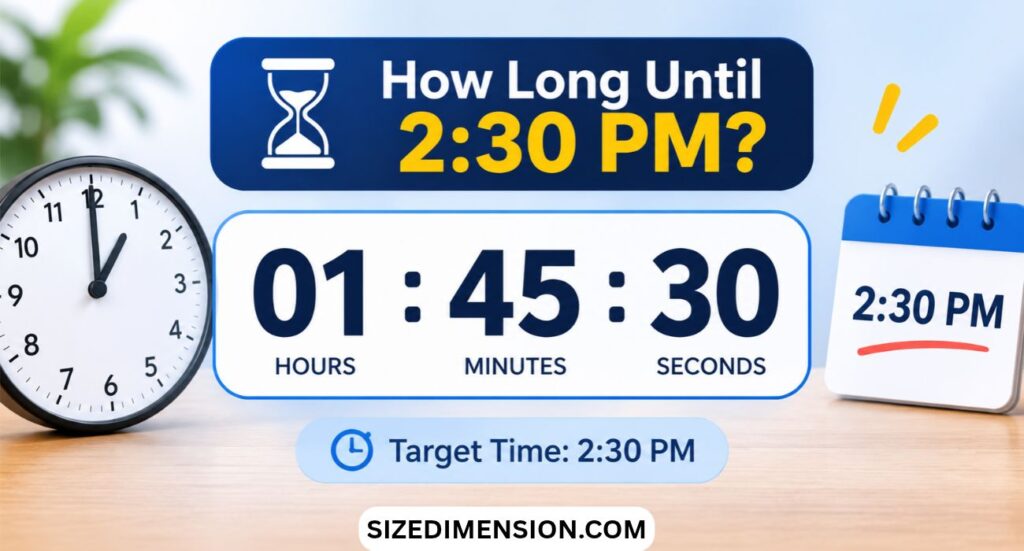
2:30 PM Countdown
Target time
02:30 PM
Your target time for today
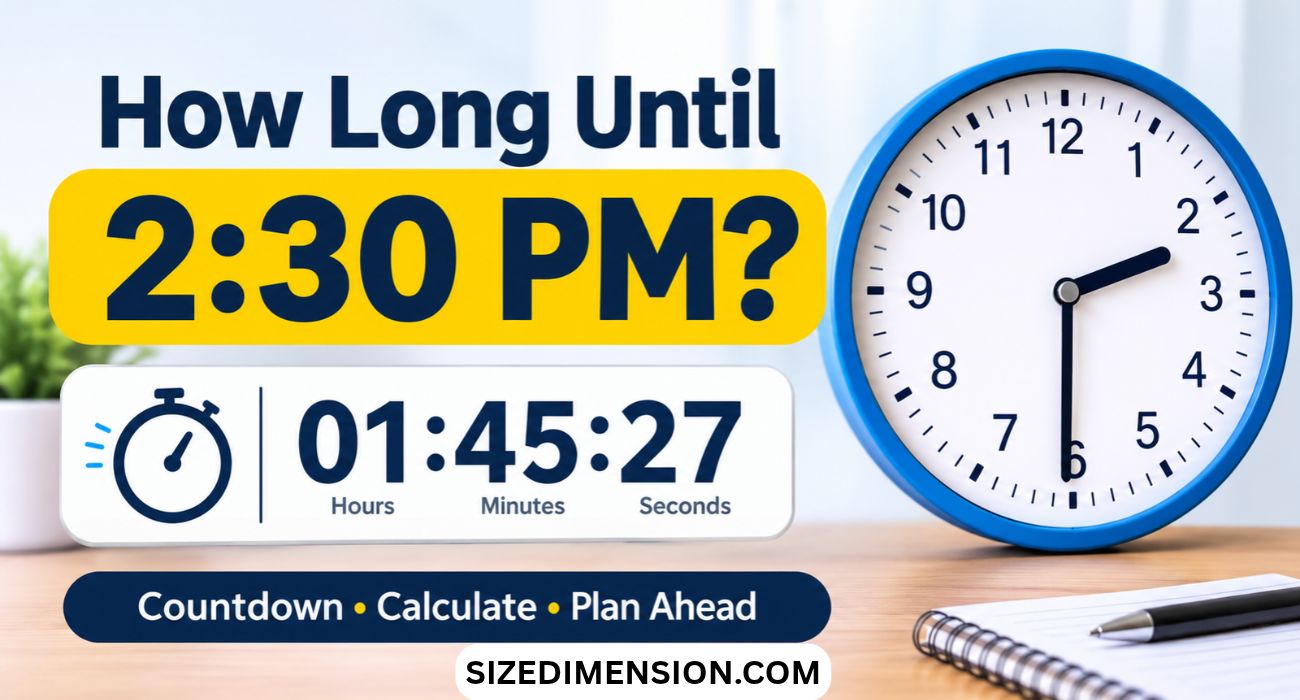
The remaining time changes continuously based on your current clock. Use a live countdown timer to see the exact hours, minutes, and seconds left.
One important detail is the difference between 2:30 AM and 2:30 PM. The former occurs during the night or early morning, while the latter is in the afternoon.
If 2:30 PM has already passed, the next occurrence is tomorrow afternoon.
How Long Until 2:30 PM Using Manual Time Calculation
You can calculate the time remaining until 2:30 PM using basic subtraction. This method works with any clock, even when you don’t have access to a digital countdown tool.
Follow these simple steps:
Step 1: Check your current time.
Look at your phone, computer, wristwatch, or another reliable clock.
Step 2: Identify your target time.
For this calculation, the target is 2:30 PM.
Step 3: Convert both times into minutes.
There are 60 minutes in an hour. Converting the times into minutes makes subtraction easier.
For example:
- 1:00 PM = 780 minutes after midnight.
- 2:30 PM = 870 minutes after midnight.
Step 4: Subtract the current time from the target time.
870 − 780 = 90 minutes.
Step 5: Convert the result into hours and minutes.
90 minutes equals 1 hour and 30 minutes.
Therefore, if the current time is 1:00 PM, you have 1 hour and 30 minutes until 2:30 PM.
Simple Time Calculation Formula
You can use this formula:
\[ \text{Remaining Time}=\text{Target Time}-\text{Current Time} \]
When working with minutes:
\[ \text{Remaining Minutes}=\text{Target Minutes}-\text{Current Minutes} \]
If your target time has already passed, calculate the difference until 2:30 PM the following day.
This approach is especially helpful when planning appointments, work sessions, study periods, and other scheduled activities.
Why People Search “How Long Until 2:30 PM”
People search for specific times because daily schedules often depend on particular hours and deadlines.
Although 2:30 PM might seem like an ordinary afternoon time, it can represent an important point in someone’s routine.
Here are some common reasons people want to know the remaining time.
1. Upcoming meetings
Employees may have meetings scheduled for 2:30 PM. Knowing the remaining time helps them prepare documents, review information, and finish earlier tasks.
2. School and college schedules
Students often use countdowns to determine how long they have before an afternoon class, examination, or study session.
3. Medical appointments
Patients may need to leave home before a 2:30 PM appointment. A countdown helps them estimate preparation and travel time.
4. Work deadlines
Some projects have afternoon submission deadlines. Knowing how much time remains helps workers prioritize important tasks.
5. Personal plans
People may be waiting for a delivery, phone call, family visit, or another scheduled activity.
6. Daily breaks
For someone working through the afternoon, 2:30 PM might represent a planned lunch break, coffee break, or short period of rest.
In each situation, a countdown provides a simple visual reminder of how much time is available.
Best Tools to Check the Time Until 2:30 PM
Several digital tools can help you track the remaining time until 2:30 PM. The best option depends on whether you need a quick calculation, an active countdown, or a reminder.
1. Online countdown timers
Online countdown timers display the remaining hours, minutes, and seconds. They are convenient when you want to monitor a specific target time without calculating anything manually.
2. Smartphone clock applications
Most smartphones include clock applications with alarm and timer features. You can set an alarm for 2:30 PM to receive an alert when your target time arrives.
3. Computer clocks
Desktop and laptop clocks allow you to check the current time quickly. You can also use calendar reminders to keep track of important afternoon events.
4. Smartwatches
Smartwatches provide convenient access to the current time and scheduled notifications. They are useful when you’re working, exercising, or moving between locations.
For a quick answer, an online countdown timer is usually the simplest choice. For an important appointment, setting an alarm provides an additional reminder.
How Long Until 2:30 PM and Better Time Management
Knowing how long until 2:30 PM can help you organize your afternoon more effectively.
Instead of watching the clock repeatedly, divide the available time into manageable tasks.
For example, imagine that it is currently 12:30 PM and you have two hours before your appointment.
You could organize your schedule like this:
| Time | Activity |
|---|---|
| 12:30–1:00 PM | Finish urgent work |
| 1:00–1:30 PM | Respond to messages |
| 1:30–2:00 PM | Prepare for the appointment |
| 2:00–2:15 PM | Take a short break |
| 2:15–2:30 PM | Final preparations |
This simple schedule gives every activity a specific time slot.
Time awareness can also help you avoid procrastination. When you know that you have only 30 minutes remaining, you’re more likely to focus on the most important task instead of starting something that requires an hour.
However, remember to include a reasonable buffer for unexpected interruptions.
How Long Until 2:30 PM in Your Daily Routine

The importance of a 2:30 PM countdown can vary depending on your lifestyle.
For some people, it marks the middle of a workday. For others, it may be the beginning of an afternoon activity.
Here are a few practical situations.
Office workers: Employees can use 2:30 PM as a meeting reminder or a checkpoint for completing important assignments.
Students: A countdown can help students prepare for afternoon classes, tutoring sessions, and examinations.
Remote workers: People working from home can divide their day into focused sessions and use 2:30 PM as a deadline for completing specific tasks.
Parents: Parents may use this time to organize school pickups, children’s activities, or household responsibilities.
Freelancers: Independent professionals can schedule client calls, project reviews, and delivery deadlines around a particular afternoon hour.
The main benefit is better awareness of available time. A countdown doesn’t automatically improve productivity, but it can make planning easier.
The Psychology of Waiting
Have you ever noticed that five minutes can feel much longer when you’re waiting for something important?
This experience is common. Our perception of time can change depending on attention, emotions, expectations, and the activity we’re doing.
When you’re excited about an upcoming event at 2:30 PM, you might keep checking the clock. This repeated attention makes you more aware of every passing minute.
On the other hand, when you’re completely focused on an interesting task, time may seem to pass quickly.
Several factors can influence how long waiting feels:
- Anticipation: Looking forward to an event can make the wait feel more noticeable.
- Boredom: Having nothing meaningful to do can make each minute feel longer.
- Anxiety: Worrying about an appointment or deadline can increase your awareness of time.
- Distraction: Engaging in a useful activity can make waiting feel less frustrating.
- Expectations: When you expect something to happen soon, you may check the clock more frequently.
One practical solution is to stop monitoring the countdown constantly. Instead, choose a small activity and check the time at reasonable intervals.
Read more: What time it was six hours ago
Productivity Tips While Waiting Until 2:30 PM
Waiting for a particular time doesn’t mean you have to waste the minutes leading up to it.
Even a short period can be useful when you choose an activity that matches the available time.
Here are some practical ideas.
1. Complete a Small Task
Choose something that can be completed in 10–20 minutes. Organizing your desk, replying to an important email, or reviewing a document can make productive use of a short waiting period.
2. Organize Your Priorities
Write down the three most important things you need to accomplish during the afternoon. This gives you a clear direction instead of jumping between unrelated activities.
3. Take a Short Break
If you’ve been working for several hours, use the available time to stretch, drink water, or relax your eyes.
4. Prepare for Your Next Appointment
Gather the documents, notes, or materials you need before 2:30 PM. Preparing early can reduce last-minute stress.
5. Learn Something New
A short educational video, a few pages of a book, or a quick language lesson can turn waiting time into a learning opportunity.
6. Avoid Constant Clock Checking
Checking the countdown every few seconds rarely makes time pass faster. Set a reminder and focus on something useful until it arrives.
The goal isn’t to fill every available minute with work. It’s to use your time intentionally while leaving room for rest.
Countdown Tools That Make Life Easier
A countdown timer is more than a digital clock. It is a practical way to measure the time between the present moment and a future event.
Different countdown tools offer different features.
| Countdown feature | Main benefit | Best use |
|---|---|---|
| Live countdown | Shows changing time remaining | Watching a deadline |
| Digital clock | Displays current local time | Everyday time checking |
| Alarm | Sends an alert at a selected time | Appointments |
| Stopwatch | Measures elapsed time | Timed activities |
| Calendar reminder | Keeps track of scheduled events | Meetings and planning |
| Browser timer | Works without installing an app | Quick countdowns |
Some online countdown tools also display seconds, allow custom target times, or offer full-screen timer displays.
When choosing a tool, consider accuracy, ease of use, and whether it automatically adjusts to your local time zone.
A useful countdown should make time easier to understand, not create unnecessary distractions.
Manual vs. Automatic Time Calculators
Both manual calculations and automatic countdown tools can tell you how long remains until 2:30 PM. However, they serve slightly different purposes.
| Feature | Manual calculation | Automatic countdown |
|---|---|---|
| Accuracy | Depends on your calculation | Depends on the clock and tool |
| Speed | Requires basic subtraction | Provides an instant result |
| Seconds display | Requires additional calculation | Usually available |
| Internet connection | Not required | Depends on the tool |
| Learning value | Helps develop time skills | Offers convenience |
| Best for | Simple calculations | Continuous tracking |
Advantages of Manual Calculation
Manual calculation is useful when you want to understand the relationship between hours and minutes.
It also works without an internet connection or specialized software.
However, it can become inconvenient when you need to calculate changing seconds or monitor a countdown continuously.
Advantages of Automatic Calculators
Automatic countdown tools update the remaining time without requiring repeated calculations.
They are particularly useful for:
- Important appointments
- Online meetings
- Work deadlines
- Study sessions
- Personal reminders
- Scheduled events
One limitation is that an online timer may depend on your device’s clock and time zone settings. If those settings are incorrect, the displayed countdown may also be incorrect.
For important events, check your device’s date, time, and time zone before relying on a countdown.
What Happens When 2:30 PM Has Already Passed?
If your current local time is later than 2:30 PM, the countdown for today’s target has ended.
However, you can still calculate the time remaining until 2:30 PM tomorrow.
For example:
- At 2:45 PM, tomorrow’s 2:30 PM is 23 hours and 45 minutes away.
- At 4:00 PM, tomorrow’s 2:30 PM is 22 hours and 30 minutes away.
- At 8:00 PM, tomorrow’s 2:30 PM is 18 hours and 30 minutes away.
- At 11:00 PM, tomorrow’s 2:30 PM is 15 hours and 30 minutes away.
This is useful when you have a recurring appointment or a daily activity scheduled for the same afternoon time.
Remember that the calculation should use the relevant local date and time zone.
Real-Life Examples
The easiest way to understand a countdown until 2:30 PM is to examine a few everyday examples.
The following calculations assume that the target is 2:30 PM on the same day unless otherwise stated.
Example 1: 1:30 PM
Suppose your current time is 1:30 PM.
Your target time is 2:30 PM.
The calculation is:
2:30 PM − 1:30 PM = 1 hour.
1 hour remaining
You have 60 minutes to finish a task, prepare for a meeting, or take a short break.
Example 2: 2:10 PM
Imagine checking your clock at 2:10 PM.
Your target is only 20 minutes away.
The calculation is:
2:30 PM − 2:10 PM = 20 minutes.
20 minutes remaining
This is a good time to finish small tasks and prepare for your next activity.
Example 3: 2:25 PM
At 2:25 PM, you have very little time left.
2:30 PM − 2:25 PM = 5 minutes.
5 minutes remaining
You can use these final minutes to organize your materials or get ready for an appointment.
Example 4: 2:29 PM
If your clock shows 2:29 PM, the target is almost here.
2:30 PM − 2:29 PM = 1 minute.
1 minute remaining
At this point, you only need to wait another 60 seconds.
Example 5: 3:00 PM
What if the current time is already 3:00 PM?
Today’s 2:30 PM has passed, so calculate the difference until tomorrow.
From 3:00 PM to midnight = 9 hours.
From midnight to 2:30 PM = 14 hours and 30 minutes.
Total:
9 hours + 14 hours 30 minutes = 23 hours 30 minutes.
23 hours 30 minutes until tomorrow’s 2:30 PM
These examples show why checking whether your target time has already passed is an important part of accurate countdown calculations.
See also: How long until 2:20
How to Set a Countdown for 2:30 PM
If you want to receive a notification when 2:30 PM arrives, setting a countdown or alarm is straightforward.
Follow these steps:
- Open the clock application on your smartphone or computer.
- Select the alarm or reminder option.
- Choose 2:30 PM as your target time.
- Confirm that the AM/PM setting is correct.
- Save the alarm or reminder.
- Keep your device’s notification settings enabled.
If you’re using an online countdown timer, select the option to create a countdown to a specific date and time, then enter 2:30 PM.
For recurring events, check whether your chosen application supports daily or weekly reminders.
An alarm is especially useful when you need to step away from your screen or concentrate on another activity.
Frequently Asked Questions
How long until 2:30 PM today?
The time remaining until 2:30 PM depends on your current local time. For example, if it is 1:00 PM, you have 1 hour and 30 minutes remaining. If it is 2:00 PM, you have 30 minutes left.
Check your local clock and subtract the current time from 2:30 PM to get the exact result.
How many minutes until 2:30 PM?
The number of minutes depends on the current time.
For example:
- From 1:30 PM: 60 minutes.
- From 2:00 PM: 30 minutes.
- From 2:10 PM: 20 minutes.
- From 2:20 PM: 10 minutes.
- From 2:25 PM: 5 minutes.
A live countdown timer can display the exact number of remaining minutes and seconds.
How many hours until 2:30 PM?
There is no fixed number of hours because the answer changes throughout the day.
For example, if the current time is 11:30 AM, there are exactly 3 hours until 2:30 PM. At 12:30 PM, there are 2 hours remaining, while at 1:30 PM, only 1 hour remains.
What is 2:30 PM in 24-hour time?
2:30 PM in the 24-hour clock format is 14:30.
The 24-hour clock uses numbers from 00:00 to 23:59, making it easier to distinguish morning and afternoon times without using AM or PM.
What happens if 2:30 PM has already passed?
If 2:30 PM has already passed in your local time zone, the next occurrence is tomorrow at 2:30 PM.
For example, if it is currently 3:00 PM, you must wait 23 hours and 30 minutes until the next 2:30 PM.
Is there an easy way to count down to 2:30 PM?
Yes. An online countdown timer is one of the easiest ways to track the time until 2:30 PM.
Simply select your target time and let the timer calculate the remaining hours, minutes, and seconds automatically. You can also use your smartphone’s alarm or reminder application.
Why does waiting for 2:30 PM sometimes feel longer?
Waiting can feel longer when you’re bored, excited, anxious, or frequently checking the clock.
When your attention is focused on the passage of time, you may become more aware of each minute. Doing something interesting or productive can make the waiting period feel easier.
Can I use a countdown timer for another time?
Yes. Most countdown timers allow you to select a different target time.
You can create countdowns for 3:00 PM, 5:30 PM, midnight, an upcoming appointment, a birthday, or another important event. Just make sure the correct date and time zone are selected.
Conclusion
A countdown to 2:30 PM is a simple but useful way to understand how much time remains before an important afternoon event. Whether you’re preparing for work, attending a class, managing appointments, or organizing personal activities, knowing the remaining time can help you plan more effectively.
Use a digital countdown for instant results or calculate the difference manually when needed. Either way, staying aware of your schedule helps you make better use of every hour.