
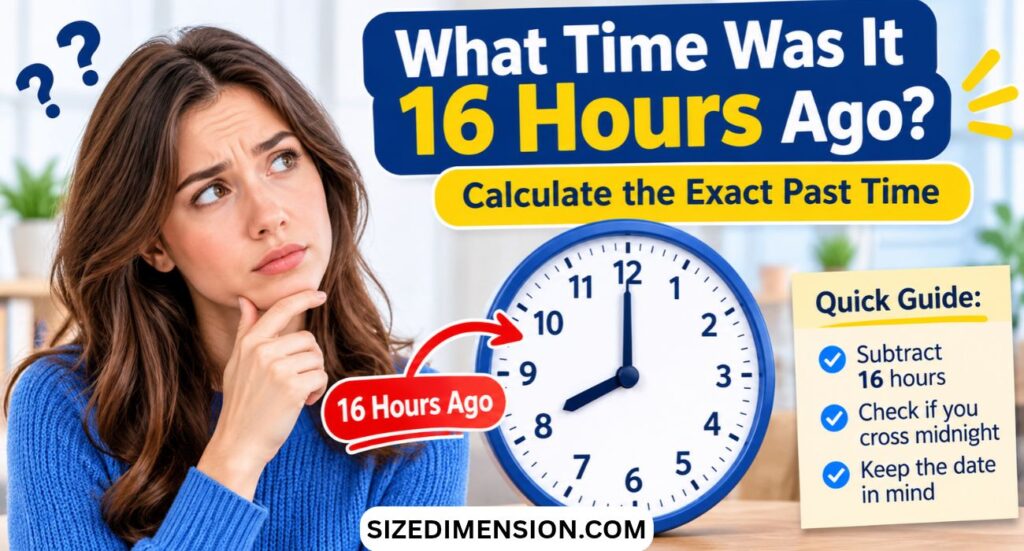
What Time Was It 16 Hours Ago? Calculate the Exact Past Time
If you have ever wondered, what time was it 16 hours ago, the answer depends on your current local time. Calculating this time difference is straightforward: simply subtract 16 hours from the time on your clock.
For example, if the current time is 8:00 PM, 16 hours earlier it was 4:00 AM on the same day. However, if it is 10:00 AM now, the answer is 6:00 PM on the previous day.
Although subtracting 16 hours sounds simple, crossing midnight, switching between AM and PM, and dealing with different time zones can sometimes make the calculation confusing.
In this guide, you will learn how to calculate 16 hours ago manually, understand clock arithmetic, use practical examples, and determine the exact past time without making common mistakes.
Read also: How long until 12:30?
Why Do People Search “What Time Was It 16 Hours Ago”?
People search for past-time calculations for many everyday reasons. Sometimes they want to remember when something happened. Other times, they need to verify a timestamp, check a work schedule, or understand how much time has passed since an event.
A 16-hour time difference is particularly interesting because it often crosses midnight.
For example:
- Someone checking a message may want to know when it was originally sent.
- An employee may need to calculate the beginning of a previous work period.
- A person tracking sleep may want to determine when they went to bed.
- Someone reviewing an online activity record may need to convert a relative timestamp into a clock time.
- A traveler may want to compare the current time with an earlier event.
The important thing to understand is that 16 hours ago does not always mean yesterday. Depending on the current time, the answer could fall on either the previous calendar day or the current day.
How to Calculate 16 Hours Ago

The easiest way to calculate 16 hours ago is to subtract 16 from the current hour while keeping the minutes unchanged.
Basic formula:
Past time = Current time − 16 hours
For example, suppose your current time is 9:30 PM.
- Convert 9:30 PM into 24-hour format: 21:30.
- Subtract 16 hours: 21:30 − 16:00.
- The result is 05:30.
Therefore, 16 hours ago was 5:30 AM on the same calendar day.
If the subtraction produces a negative hour, subtract 16 and add 24 to determine the correct clock time. The date will then move back by one day.
Quick Calculation Table
Here are some examples of how the calculation works:
| Current time | Time 16 hours ago |
|---|---|
| 12:00 AM | 8:00 AM (previous day) |
| 3:00 AM | 11:00 AM (previous day) |
| 6:00 AM | 2:00 PM (previous day) |
| 9:00 AM | 5:00 PM (previous day) |
| 12:00 PM | 8:00 PM (previous day) |
| 3:00 PM | 11:00 PM (previous day) |
| 6:00 PM | 2:00 AM (same day) |
| 9:00 PM | 5:00 AM (same day) |
| 11:00 PM | 7:00 AM (same day) |
This table assumes ordinary clock arithmetic without a daylight-saving transition.
Understanding Clock Arithmetic
Clock arithmetic is based on a repeating 24-hour cycle.
Unlike ordinary subtraction, where negative numbers can remain negative, clock calculations wrap around after reaching 24 hours.
For example:
- 23:00 represents 11:00 PM.
- 24:00 is equivalent to 00:00 on the following day.
- 25:00 can be interpreted as 1:00 AM on the following day.
When calculating an earlier time, you move backward through this 24-hour cycle.
A useful mathematical approach is:
\[ \text{Past hour}=(H-16)\bmod 24 \]
Here, \(H\) represents the current hour in 24-hour format.
The modulo operation ensures that the result stays within the 0–23 hour range.
For example:
\[ (10-16)\bmod 24=18 \]
Therefore, if it is currently 10:00 AM, the clock time 16 hours earlier is 18:00, or 6:00 PM.
The previous calendar date must also be considered.
Crossing the Midnight Boundary
Crossing midnight is one of the most common reasons people make mistakes when calculating past times.
Midnight marks the beginning of a new calendar day. When you subtract enough hours to move before midnight, the date changes.
Consider these examples:
Example 1: Current time is 2:00 AM
Subtracting 16 hours gives 10:00 AM on the previous day.
Example 2: Current time is 11:00 AM
Subtracting 16 hours gives 7:00 PM on the previous day.
Example 3: Current time is 8:00 PM
Subtracting 16 hours gives 4:00 AM on the same day.
The key distinction is that a clock time and a calendar date are two different pieces of information.
A result such as 4:00 AM is incomplete if you need to identify the exact date of an event.
For accurate calculations, always consider both.
12-Hour Clock System vs. 24-Hour Time
There are two common ways to display time.
The 12-hour clock divides the day into two periods:
- AM: Midnight through the morning until just before noon.
- PM: Noon through the evening until just before midnight.
The 24-hour clock uses numbers from 00:00 to 23:59, eliminating the need for AM and PM.
Both systems can calculate a 16-hour difference accurately.
| 12-hour format | 24-hour format |
|---|---|
| 6:00 AM | 06:00 |
| 9:00 AM | 09:00 |
| 12:00 PM | 12:00 |
| 3:00 PM | 15:00 |
| 6:00 PM | 18:00 |
| 9:00 PM | 21:00 |
| 11:00 PM | 23:00 |
| 12:00 AM | 00:00 |
The 24-hour system is particularly useful when working with schedules, digital timestamps, international travel, and computer records.
It also reduces confusion between morning and evening times.
What Happens Inside a Time Difference Calculator?
A time difference calculator performs the same basic arithmetic that you would do manually, but it handles the calculations automatically.
A typical calculator follows these steps:
- Reads the starting time or current timestamp.
- Converts the time into a consistent numerical format.
- Subtracts the requested duration.
- Adjusts the result when it crosses midnight.
- Calculates the corresponding calendar date.
- Displays the result in a readable format.
For example, if you enter 16 hours as the duration and 20:30 as the current time, the calculator subtracts 16 hours and returns 04:30 on the same date.
More advanced date-and-time calculators can also account for:
- Different time zones.
- Calendar dates.
- Seconds and minutes.
- Daylight-saving transitions.
- Larger time differences.
- Future and past timestamps.
A simple clock calculator may not account for all these factors, so choose an appropriate tool when working with international timestamps or important records.
Local Time and Time Zones Matter More Than You Think
Your current local time is important when determining what time it was 16 hours ago.
For example, if it is 8:00 PM in one location, subtracting 16 hours gives 4:00 AM locally.
However, another country may have a different clock time at that exact moment.
This happens because the world is divided into time zones. Many locations use offsets from Coordinated Universal Time (UTC), although the exact offset can change because of daylight-saving rules.
Consider someone checking an online message sent from another country.
The message may display a timestamp based on:
- The sender’s local time.
- The recipient’s local time.
- A server’s configured time zone.
- UTC.
These timestamps can look different even when they represent the same instant.
What Is UTC?
Coordinated Universal Time (UTC) is the global reference standard used for coordinating time.
It provides a consistent reference point for international communication, computer systems, and digital records.
For example:
- UTC is 12:00.
- A location using UTC+2 has a local time of 2:00 PM.
- A location using UTC−5 has a local time of 7:00 AM.
When calculating 16 hours ago, use the same time zone for both the current timestamp and the resulting timestamp unless you are intentionally converting between locations.
Does Daylight Saving Time Change the Result?
It can.
In locations that observe daylight-saving time, clocks may move forward or backward by one hour.
This means subtracting 16 elapsed hours from a timestamp can produce a different local clock reading than simply subtracting 16 from the displayed hour.
For ordinary everyday calculations, basic subtraction is usually sufficient. However, for precise historical records, use a date-aware calculator that understands the relevant time zone and daylight-saving rules.
Real-Life Examples of Calculating 16 Hours Ago
The following examples demonstrate how to calculate the exact past time under different starting conditions.
Example 1: Current Time Is 8:00 PM
Suppose the current time is 8:00 PM.
Convert it to 24-hour format:
20:00
Subtract 16 hours:
20:00 − 16:00 = 04:00
Answer
16 hours ago was 4:00 AM on the same day.
Example 2: Current Time Is 10:00 AM
Suppose the current time is 10:00 AM.
Convert it to 24-hour format:
10:00
Subtract 16 hours:
10:00 − 16:00 = −06:00
Add 24 hours to wrap around the clock:
−06:00 + 24:00 = 18:00
Answer
16 hours ago was 6:00 PM on the previous day.
Example 3: Current Time Is 3:30 PM
Convert 3:30 PM into 24-hour format:
15:30
Subtract 16 hours:
15:30 − 16:00 = −00:30
Move backward across midnight:
23:30 on the previous day.
Answer
16 hours ago was 11:30 PM on the previous day.
Example 4: Current Time Is 7:45 AM
Convert the time:
07:45
Subtract 16 hours:
07:45 − 16:00 = −08:15
Add 24 hours:
15:45 on the previous day.
Answer
16 hours ago was 3:45 PM on the previous day.
Example 5: Current Time Is 11:20 PM
Convert the time:
23:20
Subtract 16 hours:
23:20 − 16:00 = 07:20
Answer
16 hours ago was 7:20 AM on the same day.
These examples show why the current time determines whether the calculation stays within the same date or moves into the previous day.
Why Human Memory Doesn’t Work Like a Clock
People often remember events through their general context rather than exact timestamps.
You might remember having dinner, receiving a message, attending a meeting, or finishing a task without remembering precisely when it happened.
This is normal.
Human memory is not a digital recording system. Memories can preserve the order and meaning of events without retaining an exact clock time.
For example, someone might remember checking their phone before going to bed. However, they may not remember whether that happened at 9:30 PM or 10:15 PM.
Calculating 16 hours backward can help establish a possible time window, but it cannot independently verify when an event actually occurred.
For accurate confirmation, compare your calculation with reliable timestamps, calendar entries, messages, or other records.
Timeline Reconstruction in Everyday Life
Timeline reconstruction means arranging events in chronological order to understand when things happened.
Calculating 16 hours ago can be useful when building a timeline.
Imagine the following sequence:
| Event | Time |
|---|---|
| Current time | 8:00 PM |
| Earlier activity | 4:00 AM |
| Morning meeting | 9:00 AM |
| Afternoon task | 2:00 PM |
| Evening review | 8:00 PM |
This timeline helps place an earlier event in relation to other activities.
Timeline reconstruction is useful for:
- Reviewing work activities.
- Understanding communication history.
- Organizing personal schedules.
- Checking when a task was completed.
- Comparing digital activity records.
However, remember that an estimated time and a verified timestamp are not necessarily the same thing.
Use original records whenever accuracy is important.
The Psychology Behind Time Perception
Time perception describes how people experience the passage of time.
Sometimes 16 hours can feel surprisingly short. On other occasions, the same duration may seem much longer.
Several everyday factors influence this experience:
Activity level: A busy day may seem to pass quickly because attention is focused on tasks.
Sleep: Sleeping for several hours can make the period feel shorter because people are less aware of passing time.
Attention: Waiting for something can make time feel slower than when someone is occupied.
Memory: People often estimate elapsed time based on remembered activities rather than exact clock readings.
This explains why someone may feel that an event happened recently even when 16 hours have already passed.
Clock time provides an objective measurement, while perceived time describes a subjective experience.
Read more: How long until 2:30 PM?
Technology Makes Time Calculations Effortless
Modern devices make calculating past times easier than ever.
Instead of manually subtracting hours, you can use several digital tools.
Smartphone Clock and Calendar Apps
Most smartphones include clock and calendar applications.
You can use them to review schedules, compare event times, and check dates.
Online Time Calculators
An online time calculator can subtract hours, minutes, or seconds from a selected timestamp.
These tools are especially helpful when you need to calculate longer time differences.
Spreadsheet Software
Programs such as Microsoft Excel and Google Sheets can perform date-and-time arithmetic.
For example, if cell A1 contains a valid date and time, the following formula calculates 16 hours earlier:
=A1-TIME(16,0,0)Format the result as a date and time to display both parts correctly.
Digital Activity Logs
Messaging platforms, email services, websites, and operating systems often record timestamps.
These records can help you identify when an activity happened, although the displayed time may depend on the application’s time-zone settings.
Common Situations Where You Need to Calculate 16 Hours Ago
Calculating a past time is useful in more situations than people initially realize.
Work Schedules
Employees may need to determine when a shift started or when a previous work activity occurred.
For example, if a work-related event happened 16 hours before 8:00 PM, it occurred at 4:00 AM that day.
Always use the appropriate workplace timekeeping records when verifying official working hours.
Sleep Tracking
Sleep tracking applications record when users go to bed, wake up, and experience different sleep stages.
Subtracting 16 hours can help establish a reference point when reviewing a sleep schedule.
However, the calculation alone does not establish how long someone actually slept.
Social Messaging
Messaging applications often display labels such as “16 hours ago.”
If you know the current timestamp, you can calculate the approximate clock time when the message was sent.
For example, if the current time is 10:00 AM, a message marked 16 hours ago corresponds to approximately 6:00 PM on the previous day.
Some applications round relative timestamps, so the displayed label may not represent an exact 16-hour interval.
Meeting Time Verification
If you need to remember when a meeting invitation arrived or when a discussion took place, calculating backward can help.
Compare the result with calendar notifications, email timestamps, or meeting records for confirmation.
Security and Digital Records
Security systems and digital platforms frequently store timestamps for activities such as account access, file changes, and system events.
Calculating 16 hours backward can help identify the relevant period.
For investigations or official verification, use the original timestamp, its time zone, and the system’s logging conventions rather than relying only on manual calculations.
Manual Calculation vs Digital Tools
Both manual calculations and digital tools can determine a time 16 hours earlier.
The best method depends on how precise your answer needs to be.
| Feature | Manual calculation | Digital calculator |
|---|---|---|
| Speed | Quick for simple calculations | Usually very quick |
| Accuracy | Depends on the calculation | High when correctly configured |
| Midnight handling | Requires attention | Usually automatic |
| Date calculation | Must be checked manually | Often automatic |
| Time-zone support | Requires additional knowledge | Available in advanced tools |
| Daylight-saving support | Difficult manually | Available in date-aware tools |
| Best use | Everyday time calculations | Complex or precise calculations |
For a simple question, subtracting 16 hours mentally is usually enough.
For international scheduling, official records, or daylight-saving transitions, a reliable digital date-and-time calculator is the better choice.
Practical Tips for Accurate Time Calculations
A few simple habits can make time calculations more reliable.
- Start with the exact current time. Include the minutes and seconds if precision matters.
- Use 24-hour format. It makes subtraction easier and reduces AM/PM confusion.
- Check whether midnight is crossed. If the calculation moves before 00:00, adjust the calendar date.
- Keep the time zone consistent. Do not compare timestamps from different locations without converting them.
- Account for daylight saving. Use a time-zone-aware tool when calculating across a clock change.
- Distinguish estimates from exact timestamps. A label such as “16 hours ago” may be rounded by an application.
- Verify important records. For work, security, or official documentation, check the original source.
These steps are simple, but they help prevent common mistakes.
See also: How many minutes until 4:30 PM today?
Why Understanding Time Matters
Understanding time differences is an important everyday skill.
It helps people organize their schedules, coordinate with others, review past activities, and interpret digital information.
Knowing how to calculate 16 hours ago also improves your understanding of:
- The 24-hour clock.
- Calendar-day changes.
- Time intervals.
- International time differences.
- Digital timestamps.
- Chronological event sequences.
You do not need advanced mathematics to perform these calculations. A basic understanding of subtraction and the 24-hour clock is enough for most everyday situations.
Frequently Asked Questions
What Does 16 Hours Ago Mean?
Sixteen hours ago means a point in time that occurred exactly 16 hours before the reference time.
For example, if the current time is 8:00 PM, 16 hours earlier was 4:00 AM on the same day.
The exact answer depends on the starting time and applicable time-zone rules.
How Many Minutes Are 16 Hours?
There are 960 minutes in 16 hours.
Calculation:
16 × 60 = 960 minutes.
How Many Seconds Are 16 Hours?
There are 57,600 seconds in 16 hours.
Calculation:
16 × 60 × 60 = 57,600 seconds.
Can 16 Hours Ago Be Yesterday?
Yes. If the current time is before 4:00 PM, subtracting 16 hours takes you into the previous calendar day.
For example, if it is 10:00 AM today, 16 hours ago was 6:00 PM yesterday.
If the current time is 4:00 PM or later, the result falls on the same calendar day under ordinary clock arithmetic.
How Do I Calculate 16 Hours Ago Mentally?
Convert your current time into 24-hour format and subtract 16 from the hour.
If the result is negative, add 24 and move the date back one day.
For example:
- Current time: 7:00 AM.
- Subtract 16 hours: 7 − 16 = −9.
- Add 24: −9 + 24 = 15.
The answer is 3:00 PM on the previous day.
Does the Exact Answer Depend on My Current Time?
Yes. The result changes according to your starting time.
For example:
- 8:00 PM becomes 4:00 AM on the same day.
- 10:00 AM becomes 6:00 PM on the previous day.
- 3:30 PM becomes 11:30 PM on the previous day.
The minutes generally remain unchanged when subtracting a whole number of hours.
Does the Time Zone Affect the Calculation?
Yes, particularly when comparing timestamps from different locations or calculating across daylight-saving transitions.
For an ordinary calculation, use your current local time and subtract 16 hours.
For international or historical timestamps, use the correct time zone and date-aware calculation method.
Is 16 Hours Always the Previous Day?
No. Sixteen hours ago is not always yesterday.
If the current time is earlier than 4:00 PM, the result falls on the previous calendar day.
If it is 4:00 PM or later, the result falls on the current calendar day under ordinary clock arithmetic.
Is 16 Hours the Same as 960 Minutes?
Yes. One hour contains 60 minutes.
Therefore:
16 × 60 = 960 minutes.
Both measurements represent exactly the same duration.
Can I Calculate 16 Hours Ago Without a Calculator?
Yes. You can use the 24-hour clock and basic subtraction.
Subtract 16 from the current hour. If the result is negative, add 24 and move the date back one day.
For everyday calculations, this method is usually sufficient.
Conclusion
Calculating what time was it 16 hours ago is simple once you understand the 24-hour clock and how midnight affects calendar dates.
The basic rule is to subtract 16 hours from your current time. If the calculation crosses midnight, move the date back one day.
For example, if it is 8:00 PM, the answer is 4:00 AM on the same day. If it is 10:00 AM, the answer is 6:00 PM on the previous day.
For everyday activities, manual subtraction works well. However, when dealing with international timestamps, daylight-saving changes, or important digital records, use a reliable date-and-time calculator.
Understanding these simple time calculations makes it easier to manage schedules, review past activities, and keep track of important events.