How Long Until 2:30 PM? Calculate the Exact Time Remaining Today
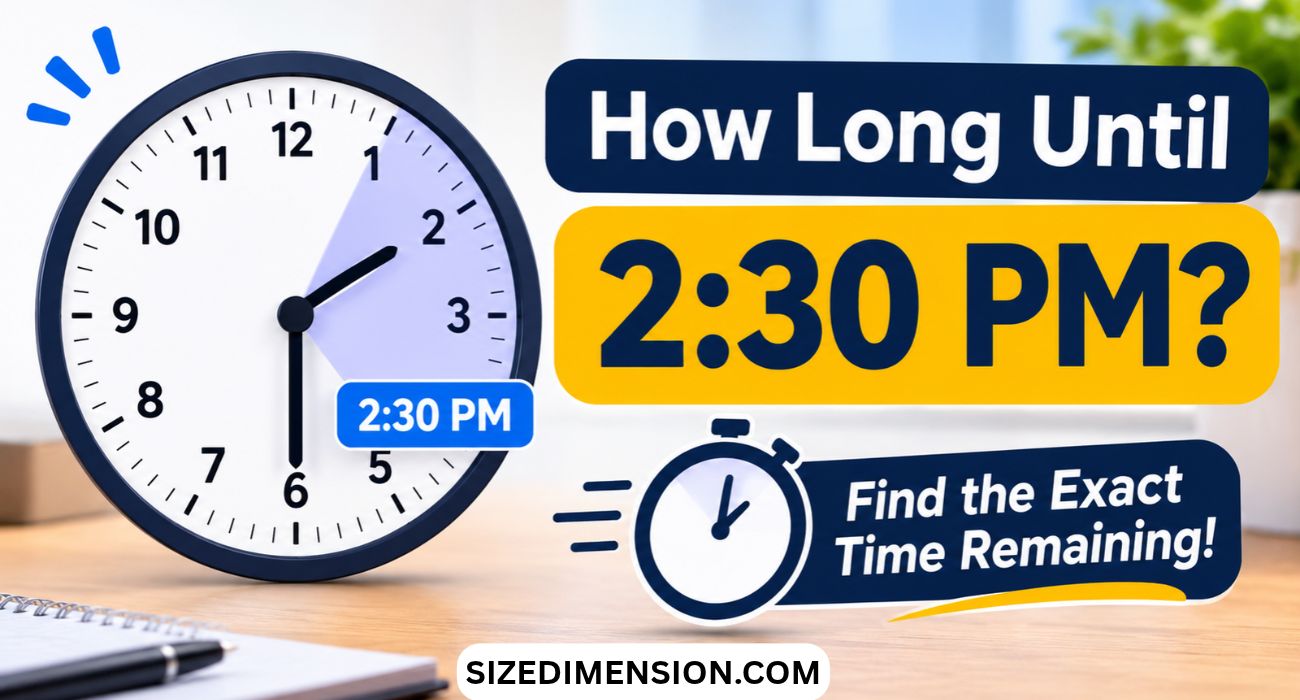
Knowing how long until 2:30 PM can help you plan your day, prepare for an appointment, manage work, or keep track of an important event. Whether you are waiting for an afternoon meeting, a school pickup, a scheduled break, or the end of a task, knowing the exact time remaining makes planning easier.
The time left until 2:30 PM changes every second. If your current local time is 1:30 PM, you have exactly one hour to wait. If it is 12:00 PM, you have two hours and 30 minutes. You can calculate this duration manually or use an online countdown calculator to get an updated result.
This guide explains how to calculate the time until 2:30 PM, understand different time formats, use live countdown tools, and manage your schedule more effectively. It also covers time zones, daylight saving time, and practical examples to help you understand the countdown.
Read also: How long until 3:30 PM
Understanding How Long Until 2:30 PM
The time until 2:30 PM represents the duration between the current local time and the next occurrence of 2:30 in the afternoon.
It is not a fixed duration because the answer depends on your current clock time. Every minute that passes reduces the remaining countdown by one minute. Every second makes the waiting period slightly shorter.
For example, consider these common situations:
| Current Time | Time Until 2:30 PM |
|---|---|
| 8:00 AM | 6 hours 30 minutes |
| 9:00 AM | 5 hours 30 minutes |
| 10:00 AM | 4 hours 30 minutes |
| 11:00 AM | 3 hours 30 minutes |
| 12:00 PM | 2 hours 30 minutes |
| 1:00 PM | 1 hour 30 minutes |
| 1:30 PM | 1 hour |
| 2:00 PM | 30 minutes |
| 2:15 PM | 15 minutes |
| 2:29 PM | 1 minute |
These examples show how the countdown changes throughout the day.
If you want to know the exact remaining duration, check your current local time first. Then compare it with 2:30 PM. The difference gives you the amount of time you have left.
Important: If it is already later than 2:30 PM, the next 2:30 PM will occur tomorrow. This distinction matters when calculating a countdown for a recurring daily event.
How Long Until 2:30 PM Changes Every Second
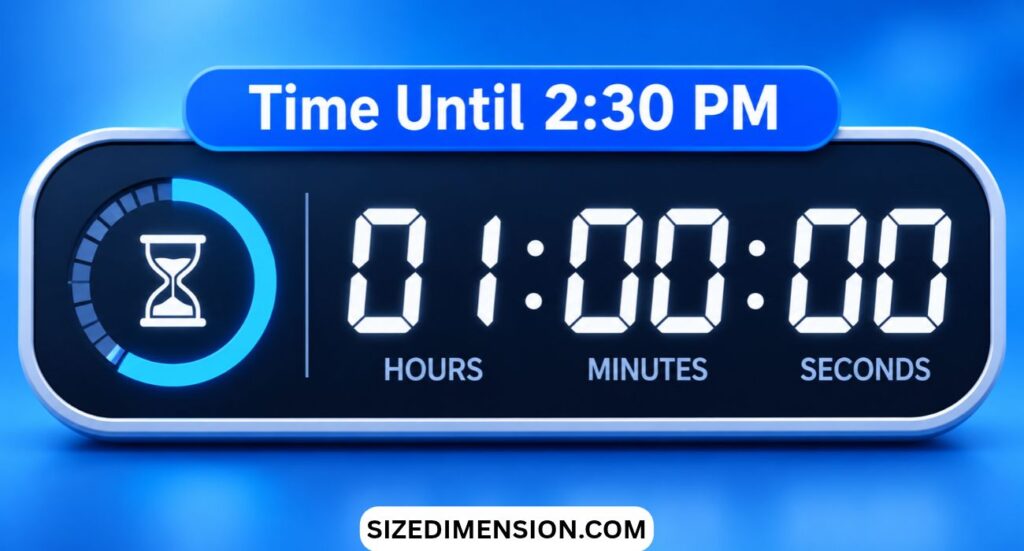
A countdown is a continuously changing measurement of time. It shows the difference between the current moment and a selected future time.
For example, suppose your clock shows 1:45 PM. You have 45 minutes until 2:30 PM.
As time passes, the remaining duration changes:
| Current Time | Remaining Time |
|---|---|
| 1:45:00 PM | 45 minutes |
| 1:50:00 PM | 40 minutes |
| 2:00:00 PM | 30 minutes |
| 2:10:00 PM | 20 minutes |
| 2:20:00 PM | 10 minutes |
| 2:25:00 PM | 5 minutes |
| 2:29:00 PM | 1 minute |
| 2:29:30 PM | 30 seconds |
| 2:29:59 PM | 1 second |
A live countdown usually displays hours, minutes, and seconds. Some tools also show days when the selected event is far away.
The countdown decreases because the target time remains fixed while the current time moves forward. Once the clock reaches 2:30 PM, the countdown reaches zero.
This is particularly useful when you have an appointment or deadline and need to know exactly how much preparation time remains.
Ways to Calculate the Time Until 2:30 PM
There are several ways to calculate the remaining time. The best method depends on how quickly you need an answer and whether you want a simple estimate or a live countdown.
Manual Calculation
Manual calculation is a straightforward way to find the time remaining until 2:30 PM. You only need the current time and basic subtraction.
Follow these steps:
- Check the current time on your phone, computer, or wall clock.
- Identify the target time, which is 2:30 PM.
- Subtract the current time from the target time.
- Convert the result into hours and minutes.
- If necessary, include the remaining seconds.
Example 1: Current time is 11:15 AM
Target time: 2:30 PM
Current time: 11:15 AM
First, calculate the hours from 11:15 AM to 2:15 PM. That gives you three hours. Then add another 15 minutes to reach 2:30 PM.
Total remaining time: 3 hours and 15 minutes.
Example 2: Current time is 12:45 PM
From 12:45 PM to 1:45 PM is one hour. From 1:45 PM to 2:30 PM is another 45 minutes.
Total remaining time: 1 hour and 45 minutes.
Example 3: Current time is 2:10 PM
The difference between 2:10 PM and 2:30 PM is 20 minutes.
Total remaining time: 20 minutes.
Manual calculation works well for everyday situations. However, it can become less convenient when you need seconds or must calculate across midnight.
Using a Countdown Calculator
An online countdown calculator provides a convenient way to check how much time remains until 2:30 PM.
Instead of subtracting the times yourself, you select the target time and allow the calculator to determine the difference.
A typical countdown calculator displays:
- Remaining hours.
- Remaining minutes.
- Remaining seconds.
- Total time until the target.
- An automatically updating countdown.
For example, if the current time is 1:20 PM, the calculator displays 1 hour and 10 minutes remaining.
A live countdown is especially helpful when you are working on something and do not want to keep checking your wall clock.
Make sure the calculator uses your intended time zone. A countdown based on the wrong location can display an incorrect result.
Using a Duration Calculator
A duration calculator helps determine the difference between two specific times.
For example, you can enter:
| Setting | Time |
|---|---|
| Start time | 10:45 AM |
| End time | 2:30 PM |
| Result | 3 hours 45 minutes |
Unlike a live countdown, a basic duration calculator generally compares two manually entered times. It does not necessarily update as the current time changes.
This tool is useful when you want to calculate work periods, waiting times, appointment durations, or the time between scheduled activities.
Understanding 2:30 PM in Different Time Formats
People use different clock formats depending on their country, workplace, devices, and personal preferences.
The two most common systems are the 12-hour clock and the 24-hour clock.
2:30 PM in the 24-hour format is 14:30.
The 12-hour clock uses AM and PM to distinguish morning from afternoon. The 24-hour system uses numbers from 00:00 through 23:59.
Here is how the same time appears in different formats:
| Time Format | Representation |
|---|---|
| 12-hour clock | 2:30 PM |
| 24-hour clock | 14:30 |
| Military time | 1430 |
| Hours and minutes | 14 hours 30 minutes |
| Digital clock | 14:30:00 |
Understanding these formats is important when reading travel schedules, medical appointments, business calendars, and international meeting invitations.
For example, an appointment listed as 14:30 means 2:30 PM, not 2:30 AM.
The 24-hour format removes the need for AM and PM labels, making it easier to distinguish morning and afternoon schedules.
Comparing 2:30 PM with Nearby Times
Understanding nearby times can help you organize your schedule and estimate how much time remains before an afternoon activity.
For example, if your meeting starts at 2:30 PM, knowing the difference between 2:00 PM, 2:15 PM, and 2:45 PM helps you plan when to finish your current task.
The following table compares 2:30 PM with nearby times.
| Target Time | Difference from 2:30 PM |
|---|---|
| 1:30 PM | 1 hour earlier |
| 1:45 PM | 45 minutes earlier |
| 2:00 PM | 30 minutes earlier |
| 2:15 PM | 15 minutes earlier |
| 2:25 PM | 5 minutes earlier |
| 2:29 PM | 1 minute earlier |
| 2:31 PM | 1 minute later |
| 2:45 PM | 15 minutes later |
| 3:00 PM | 30 minutes later |
| 3:30 PM | 1 hour later |
These comparisons are useful for everyday planning.
Suppose you need to leave home at 2:15 PM to attend an event scheduled for 2:30 PM. You have 15 minutes between departure and the event’s starting time. However, you should also consider travel time and possible delays.
A nearby-time comparison makes it easier to see whether you have enough time to finish a task before your next commitment.
Using a Live Countdown for Better Planning
A live countdown can make daily scheduling easier by showing exactly how much time remains before a particular event.
Instead of repeatedly checking the clock, you can keep a countdown visible on your computer, smartphone, or another compatible device.
Imagine that you have an online meeting at 2:30 PM. At 1:30 PM, you have one hour to prepare. At 2:00 PM, you have only 30 minutes left.
This information helps you divide your remaining time into manageable tasks.
For example, you might spend the first 20 minutes reviewing documents, the next 20 minutes preparing notes, and the final 20 minutes checking your equipment and joining the meeting.
A countdown also helps in situations such as:
- School pickup: Keep track of the time before you need to leave.
- Work meetings: Prepare documents before the scheduled starting time.
- Cooking: Monitor the remaining time before an afternoon meal.
- Online classes: Finish your current activity before the lesson begins.
- Appointments: Allow enough time to travel and arrive before the scheduled time.
- Personal breaks: Know when your scheduled rest period begins.
A countdown does not automatically make a schedule more productive. Its main benefit is that it gives you a clear view of the remaining time, helping you make better decisions.
Time Zones Matter More Than People Think
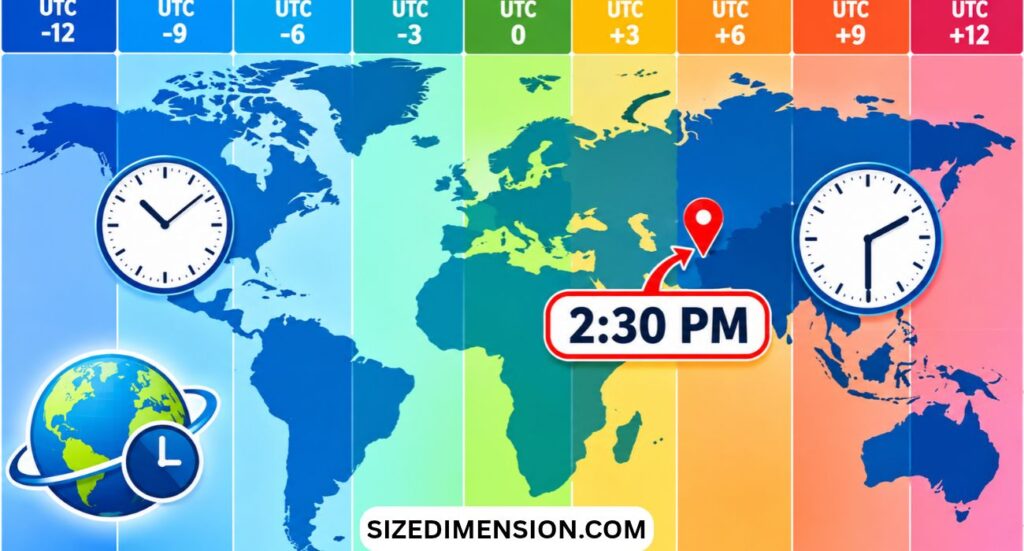
Time zones are important when calculating how long until 2:30 PM, especially when you are communicating with someone in another country.
The same clock time does not occur simultaneously everywhere in the world.
For example, 2:30 PM in New York may be a different moment from 2:30 PM in London, Islamabad, or Tokyo.
Each location follows its own local time rules. These rules determine the relationship between local time and Coordinated Universal Time (UTC).
Consider an international online meeting scheduled for 2:30 PM in New York. Someone joining from Pakistan must convert that scheduled time into Pakistan Standard Time before calculating the countdown.
Pakistan Standard Time is UTC+5. New York’s offset changes between UTC-5 and UTC-4 depending on whether standard time or daylight saving time applies.
Therefore, the time difference between these locations is not always the same.
Before calculating an international countdown, check:
- The location where the event takes place.
- The time zone used in the invitation.
- Whether the event follows local time or UTC.
- Whether daylight saving time affects either location.
- The current local time at your location.
Calendar applications often convert meeting times automatically when the correct time zones are selected.
However, it is still worth checking the displayed time before joining an important international meeting.
Daylight Saving Time Can Change Everything
Daylight saving time (DST) is a seasonal clock adjustment used in some countries and regions.
During the daylight saving period, participating locations generally move their clocks forward by one hour. When the period ends, they move their clocks back.
This change can affect the time difference between two locations.
For example, New York generally follows Eastern Standard Time (UTC-5) during standard time and Eastern Daylight Time (UTC-4) during daylight saving time.
Pakistan does not currently observe daylight saving time and generally remains on UTC+5 throughout the year.
As a result, the time difference between New York and Pakistan changes when New York switches between standard time and daylight saving time.
This matters when calculating a countdown for an event scheduled in another location.
However, if you are simply waiting for 2:30 PM on your own local clock, daylight saving time does not require a separate calculation. Your device should already display the applicable local time.
For accurate international scheduling, use a reliable time-zone converter or a calendar application that accounts for daylight saving transitions.
Read more: How Long Until 2:30 PM
Popular Tools That Help Track the Countdown
Several everyday digital tools can help you monitor the time remaining until 2:30 PM.
You do not always need specialized software. Most smartphones and computers already include basic time-management features.
Smartphone Clock Applications
Most smartphones include a clock application with alarm, stopwatch, and timer functions.
You can set an alarm for 2:30 PM to receive a notification when the target time arrives.
An alarm is useful when you do not need to watch the countdown continuously.
Online Countdown Timers
An online countdown timer allows you to select a target time and monitor the remaining duration through a web browser.
Some tools display hours, minutes, and seconds in large digital numbers.
These tools are useful for people who work on desktop computers and want a visible countdown.
Digital Calendars
Calendar applications help you organize appointments and receive reminders before scheduled events.
You can create an event for 2:30 PM and set a notification 10, 15, or 30 minutes beforehand.
This is particularly useful when you have several commitments throughout the day.
Smartwatches
Smartwatches provide quick access to timers, alarms, and notifications.
You can check the remaining time without taking your phone out of your pocket.
This can be convenient during exercise, household activities, travel, or busy work periods.
Desktop Clock Widgets
Desktop clock widgets display the current time directly on your computer screen.
Some applications also support countdown features, although availability depends on the operating system and software.
Choose a tool that provides accurate time information without unnecessary distractions.
Productivity Benefits of Knowing the Exact Countdown
Knowing how long until 2:30 PM can help you use your available time more effectively.
Many daily activities have fixed starting times. When you know exactly how much time remains, you can decide which tasks are realistic to complete before the next commitment.
For example, suppose you have a deadline at 2:30 PM and your current time is 12:30 PM.
You have two hours available.
You could divide this period into smaller working sessions:
| Activity | Time Allocation |
|---|---|
| Review important documents | 30 minutes |
| Complete the main task | 45 minutes |
| Check and correct your work | 25 minutes |
| Prepare for the next activity | 20 minutes |
| Total | 2 hours |
This approach makes a large period easier to manage.
A countdown can also support time-blocking, a scheduling method in which you assign specific periods to individual activities.
For example, you might reserve 30 minutes for emails, 45 minutes for focused work, and 15 minutes for a break.
The key is to give each activity a realistic time limit.
Knowing the remaining time can also reduce uncertainty when waiting for something important. Rather than guessing whether you have enough time, you can check the countdown and make a more informed decision.
Morning vs Afternoon Countdowns
A countdown to 2:30 PM behaves differently depending on when you start calculating it.
In the morning, the target may still be several hours away. During the afternoon, the remaining period becomes much shorter.
Understanding this difference helps you plan activities according to the time available.
Morning countdowns
If it is 8:00 AM, you have 6 hours and 30 minutes until 2:30 PM.
This provides enough time for several activities, including work, study, errands, and lunch.
A longer countdown is useful for planning multiple tasks throughout the day.
Afternoon countdowns
If it is 1:30 PM, you have only one hour remaining.
At this point, it makes sense to focus on immediate priorities rather than starting lengthy activities.
If the current time is 2:15 PM, you have just 15 minutes left.
The closer you get to the target, the more useful short-term planning becomes.
Choosing the Right Countdown Tool
The best countdown tool depends on how you want to use it.
Some people need a simple reminder, while others prefer a continuously updating display.
Consider the following comparison:
| Tool | Main Purpose | Best Use |
|---|---|---|
| Online countdown timer | Shows remaining time | Watching a live countdown |
| Smartphone alarm | Sends an alert | Remembering an appointment |
| Duration calculator | Calculates time differences | Measuring time periods |
| Digital calendar | Organizes scheduled events | Managing daily commitments |
| Smartwatch timer | Provides quick notifications | Tracking time while moving |
| Desktop clock widget | Displays current time | Keeping time visible while working |
Before choosing a tool, consider its accuracy, ease of use, and compatibility with your device.
A basic alarm is enough if you only need to remember 2:30 PM. A live countdown is better if you want to see the remaining hours, minutes, and seconds.
For recurring appointments, a calendar is generally more practical because it can manage multiple events and reminders.
You should also check whether the tool uses your device’s local time or requires you to select a time zone manually.
What Happens When 2:30 PM Has Already Passed?
One important detail is whether you want to calculate the next 2:30 PM or determine how long ago today’s 2:30 PM occurred.
If your current local time is before 2:30 PM, calculate the difference between the current time and the target.
If your current time is after 2:30 PM, today’s target has already passed.
For a countdown to the next occurrence, you must calculate the time until 2:30 PM tomorrow.
For example:
| Current Time | Time Until Next 2:30 PM |
|---|---|
| 2:00 PM | 30 minutes |
| 2:25 PM | 5 minutes |
| 2:30 PM | 24 hours |
| 3:00 PM | 23 hours 30 minutes |
| 5:00 PM | 21 hours 30 minutes |
| 10:00 PM | 16 hours 30 minutes |
| 11:30 PM | 15 hours |
This is useful for recurring daily activities, such as scheduled medication reminders, classes, meetings, or television programs.
Remember that a recurring countdown should use the next calendar occurrence of 2:30 PM rather than treating a past time as a negative duration.
See also: What Time Was It 6 Hours Ago
Common Mistakes When Calculating the Time Until 2:30 PM
Even a simple time calculation can produce incorrect results when important details are overlooked.
Understanding these common mistakes helps you get a more reliable answer.
Confusing AM and PM: 2:30 AM and 2:30 PM are 12 hours apart. Always check the correct period before calculating.
Using the wrong time zone: An event scheduled for 2:30 PM in another country may not occur at 2:30 PM on your local clock.
Forgetting the next-day rule: If today’s 2:30 PM has passed, the next occurrence is tomorrow.
Ignoring seconds: A calculation based only on hours and minutes may not show the exact remaining duration.
Using an outdated clock: A device with an incorrect time setting can produce an inaccurate countdown.
Confusing a timer with an alarm: A timer usually measures a duration, while an alarm alerts you at a specific clock time.
Checking these details takes only a moment and can prevent scheduling mistakes.
Frequently Asked Questions
How long until 2:30 PM?
The time until 2:30 PM depends on your current local time. For example, if it is 1:30 PM, you have one hour remaining. If it is 12:00 PM, you have two hours and 30 minutes. Check your current clock to calculate the exact difference.
What is 2:30 PM in 24-hour time?
2:30 PM in the 24-hour clock format is 14:30. This format uses numbers from 00:00 to 23:59 and does not require AM or PM labels.
Is 2:30 PM afternoon?
Yes, 2:30 PM is an afternoon time. It occurs after 12:00 noon and before 3:00 PM. It is commonly considered part of the early afternoon.
Why does a countdown change every second?
A countdown changes every second because the current time continuously moves closer to the selected target. As each second passes, the remaining duration decreases by one second until the countdown reaches zero.
What happens if it is already after 2:30 PM?
If the current local time is later than 2:30 PM, today’s target has passed. A countdown to the next 2:30 PM will calculate the remaining time until tomorrow afternoon.
Can I calculate the countdown without a calculator?
Yes. You can subtract the current time from 2:30 PM manually. For example, if it is 1:45 PM, there are 45 minutes remaining. For more complicated calculations involving seconds or midnight, a digital calculator can make the process easier.
Why can two people have different countdowns?
Two people can see different countdowns because they may live in different time zones or have different local clock times. If both are waiting for the same event, they must use the event’s correct time zone to calculate the same moment.
Is 14:30 the same as 2:30 PM?
Yes. Both represent exactly the same time of day. The 14:30 format belongs to the 24-hour clock, while 2:30 PM belongs to the 12-hour clock.
Conclusion
Knowing how long until 2:30 PM makes it easier to manage appointments, work schedules, personal activities, and everyday responsibilities. You can calculate the remaining time manually, use a duration calculator, or follow a live countdown that updates every second. The correct result always depends on your current local time.
For accurate planning, pay attention to AM and PM, time zones, and daylight saving changes when scheduling international events. If today’s 2:30 PM has already passed, remember that the next occurrence is tomorrow. A reliable countdown or reminder can help you stay organized and make better use of your available time.